pages

Wednesday, 10 February 2016

Going wild

Terms that I've recently come across: 'wild swimming' and 'wild camping'.  I was slightly puzzled by what these referred to, and then, with the 'ping' of a tiny light-bulb, I understood.  Although having lived in the UK for over
24 years now, occasionally I miss a wee cultural context - what is 'wild' here, is just everyday ordinary back in Australia.
We go swimming.
In the sea, in rivers, creeks, and lakes.
Oh, and in pools, too.
Up until moving to the UK, I'd never differentiated my swimming unless it was
within the context of what style I was using to move about in the water:
freestyle, breast-stroke, back-stroke, and rather poorly executed butterfly.
Up until moving to the UK, I'd never done what I'm terming 'tame swimming',
as in swimming indoors.
I just...swam.
Here, to swim 'wild' is not so much about splashing around erratically, but denotes what I always thought of as just ...swimming.
Weather differences, perhaps, factored in this cultural difference.

Growing up, and even in my young adulthood before swapping hemispheres,
I would often go camping.
Canvas.
Combi-van.
Heading off to beach inlets, taking off in the boat and setting up camp on
the islands around the 'neighbourhood', or going bush (by the by, never a great idea to pitch a tent by the banks of the Condamine River without finding out first if it's wild pig shooting season - just in case you were of a mind to do so), the great outdoors was our play area and the smell of sausages blackening on a camp fire was a
wondrous thing.
But it never came with the prefix 'wild'.
It was just simple, unadorned camping.
I'm guessing 'tame camping' is what is done if staying at a special camp-site? Y'know, the ones that have shower blocks and probably even flushing toilets.

The 'wild' thing has been gently bubbling below for a little while now, but was brought quite happily up to the surface the other week.  I was away with RevGals at the BE9. Great galship, great programme by the fabulous Jan Edmiston.  We were thinking through the cultures we find in churches and communities. Good to be reminded again that all the programmes, all the great strategic planning you might do, don't amount to a hill of beans unless you actually understand the culture of the community that you're serving.
What are the sacred cows - ha, or in my case here - sheep?
What are those things that have always been? The things that matter?
The people who have always had the say in what those things actually were and are?
Are 'the things' still working?
Are the people hanging on a little too fiercely because they're scared to let go...?
On the other hand, are they the people best-placed to be the ones who have that say,
because of wisdom gained from hard-earned experience?
There was much to chew on, and, over the course of the week, my thoughts turned to the notion of 'wild church'.
This was perhaps prompted too, by one of our ice-breaker exercises:
we were asked to line ourselves up in order of 'our idea of roughing it'.
At one end, 'roughing it' included things along the lines of  no wifi in the 5 star hotel, or no bubbles in the champagne. At the other end, well, it was a little more 'wild': with a resident Alaskan *hat tip to JS* and an expat Australian. We were very much more along the lines of a 'having to use a stick to clean a fish for lack of a knife', or 'having to use bare hands, instead of a machete. to break branches to make a sleep-shelter for the night. It was ...interesting... to see how far away the rest of the group were moving from us.

'Wild'
'Tame'
Conjures up beloved Narnia books and the oft-repeated phrase about Aslan:
'he's not a tame lion, you know.'
Have we, as church, tried to tame God?
Tried to make sure that God got with our programme?
And, in trying to domesticate God, have we ourselves become tame?
Having just observed Transfiguration on Sunday, have we missed the point?
The God on the mountaintop who meets with Moses,
the Jesus on the mountaintop whose glory is revealed to James, Peter, and John
in eye-splintering brightness, is fierce and fabulous and far from tame.
While there may be a wideness in God's mercy,
there's a wildness in God's nature that we as followers in faith cannot deny.
We need to have 'wild faith', and become 'wild church', for we have been tame
for far too long: perhaps a little too cosy and domesticated, and perhaps a little fearful of
swimming out of our depths, stepping out into the great unknown.
I wonder if wild church is a place in which there is no fear of diversity?
At the heart of wild church, is perhaps, an understanding that,
within the wildness of the Trinitarian nature of God, there is unity and diversity:
that difference is not necessarily terrible or evil, it can be wonderfully good.
Rather than swimming between the lines, staying within the lane, wild church
jumps in the sea, swims with those who aren't necessarily used to, or allowed to,
swim between the lines.
Dare we have a wild faith that mirrors the One we follow -
the One who stepped out of glory and into human skin and bone?
The One who spent time, not with the tame folk, but the wild folk on the edges...
our wild, incarnational, risk-taking God?
Some do.
And there is pain, and there is glory when they do.
Sometimes, there is name-calling, shaming, and shunnin by those who don't.

'Tame church'
'Wild church'
Up until pondering 'wild swimming' and 'wild camping' I'd never differentiated between
'tame' and 'wild' as forms of church.
I just was church - part of the body - and went to church.
Time to move from 'tame church' culture and walk on the wild side a little, I think.
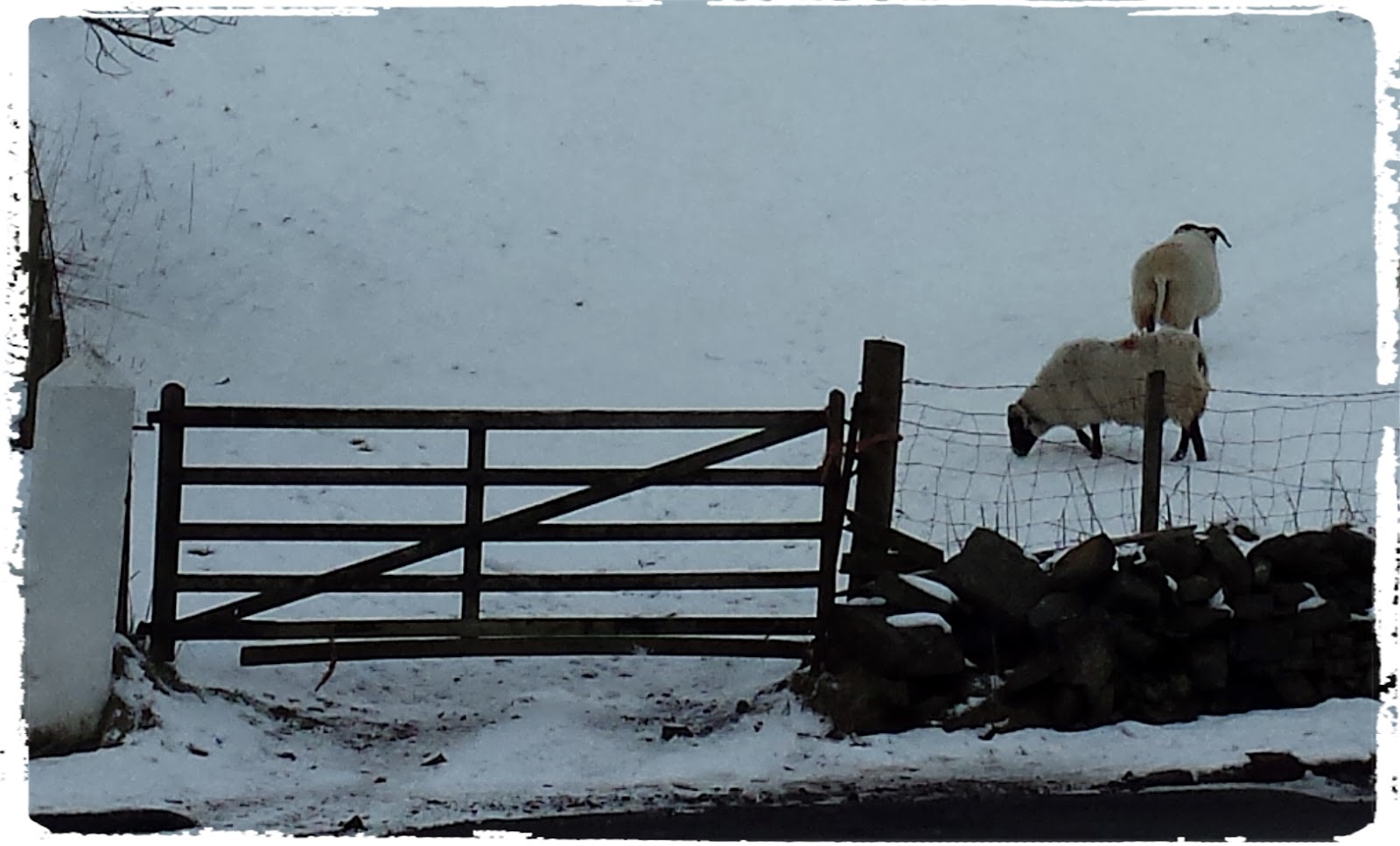
Friday, 5 February 2016

Sheep tails: Addie and Effie

Rural ministry tails...a new blog feature inspired by conversations on a cruise, with mad women.

Meet Addie and Effie [Adiaphora and Ephemera]
Addie and Eff enjoy dancing to the ABBA beatz down at the local village hall on a Friday night. Fond of the occasional margarita, these girls know how to have a good time and enjoy putting Ted the tup through his paces. Effie has a penchant for Manolo Blahniks, while Addie enjoys the occasional trip to Tiffany's to gaze soulfully at the sparkling beauty on display. Beyond their love of ABBA, both have been known to get down to the groove of 'Tequila'. If there's a party in the villages, Addie and Eff are front and centre.
Girls, we salute you!

Friday, 8 January 2016

On the other side of Epiphany

Now that the old year has shuffled 'round the corner,  
and the new is just past a week young,
with the Magi finished visiting, and their faces turned homeward,
it is high time to pack away the vestiges of Christmas.
Empty boxes sit by tree stump, waiting to be filled with baubles,
bells, a replica Empire State Building, strings of light.
Colours of gold, purple, green - royalty, deity, life;
colourless white - purity.
I am slow in putting away the season of incarnation -
of Word made flesh and blood.
Unintentional lingering due to other calls on time.
Perhaps a subtle reminder that the message
of the child in the manger is one that can't be packed away -
that the work now begins, rather than finishes.
I'm minded of words uttered by the great American preacher Howard Thurman -
a chap who had a profound influence on Martin Luther King Jr.:

"When the song of the angels is stilled,
When the star in the sky is gone,
When the kings and princes are home,
When the shepherds are back with their flock,
The work of Christmas begins:
To find the lost,
To heal the broken,
To feed the hungry,
To release the prisoner,
To rebuild the nations,
To bring peace among people,
To make music in the heart."

In the morning, before I dig the car out of the snow and head out
to visit folk, boxes containing Christmas will go back into hiding in the storage cupboard.
The message of new life, joy, liberation, and good news for all however, remains uncontained.

Sunday, 6 December 2015

'First Coming': poems for Advent/ Christmas

So out of kilter with blog posting these days...

I suspect the following, glorious poem by one of my favourite writers
will be heard over Christmas.

First Coming     

He did not wait till the world was ready,
till men and nations were at peace.
He came when the Heavens were unsteady,
and prisoners cried out for release.

He did not wait for the perfect time.
He came when the need was deep and great.
He died with sinners in all their grime,
turned water into wine. He did not wait

till hearts were pure. In joy he came
to a tarnished world of sin and doubt.
To a world like ours, of anguished shame
he came, and his Light would not go out.

He came to a world which did not mesh,
to heal its tangles, shield its scorn.
In the mystery of the Word made Flesh
the Maker of the stars was born.

We cannot wait till the world is sane
to raise our songs with joyful voice,
for to share our grief, to touch our pain,
He came with Love: Rejoice! Rejoice! 
                        -Madeleine L’Engle

Monday, 9 November 2015

Music for the soul: Be Thou my Vision


Going a little off the point for NaBloPoMo, but still on a theme of hymns...

It may take a moment to get to the point, re. the title of this blog entry:
do bear with me...
Several years ago, in conversation with a pal, we were talking about funerals we'd been to.  Having put the world to rights about why this or that was perhaps not very good, or why such and such was really rather excellent, we moved on to our own funerals: what would we like when the day came?
While it ended up becoming one of the funniest conversations I've had, it was eminently practical as well. Said friend, normally a pretty quiet and
self-composed person, declared in the end:
'No! I want to go in style - I want the full works! I want a horse-drawn hearse; the horses -
with black feather headdress, a man to lead the hearse in front,
walking slowly and seriously. I want to be taken to the church that way,
with the beat of a slow drum to keep time. And then, the total pomp
and ceremony of a funeral Mass - with clouds of incense.'
We talked on, of readings, and hymns, and giggled our way through
the thought of hiring professional mourners, as they did, back in the day.
As an aside, said friend is a Pisky, with a seriously well-developed sense of
humour, and so high up the liturgical candle that you're in danger of nose-bleed...

The practical and pragmatic outcome of the conversation was, however,
a prod to go to the solicitor and get the will sorted. In said will, there's
also a funeral arrangements file. Dull Presbyterian that I am, and knowing
I'd never compete with friend, I've noted who I'd like to conduct the thing -
if they happen to still be shuffling about this mortal coil,
and also noted a bible reading and hymn.
The reading? The Prologue of John.
I am nothing, if not an incarnation nut - that text goes deep.
It's almost the best thing about Christmas worship for me:
God's 'yes' to the world.
The surprise of expected, yet wholly unexpected love.
And the hymn?
Always, always, 'Be Thou my Vision'
Text and hymn meeting in beautiful symmetry.
The version I like the best has the line:
'be Thou my dignity, Thou my delight'
It's a comfort, especially on my more numptyish of days,
for this 8 on the Enneagram.
A reminder that in the end, it's actually going to work out fine -
that when I've lost all shred of dignity,
I stand in God's dignity.
That, in a job that's about being real,
which calls me to strip away the pretence,
God's dignity suffices.
There's the reminder to, about delight.
Delight is good.
Delighting in God, better.

Saturday, 7 November 2015

NaBloPoMo 7: 'You had me at "hello"'

The film 'Jerry Maguire' spawned a thousand parodies and memes with the line:
'You had me at "hello"'.


The opening line/s of a book can do that: grab you, and hook you in.
Today's NaBloPoMo prompt was to 'post the opening sentence of your
favourite book. How long has it been in your life?'

No. Can't play the game quite in that way.
There have been too many - are too many - friends in paper format
that have stood the test of time. Instead, I've decided to post opening gambits
to several companions in print instead - mostly from my childhood, up until
the age of 30. There may be another post to fill in blanks up until the present
at another point! In the meantime, I've loved journeying down memory lane!

''Once there were four children whose names were Peter, Susan, Edmund and Lucy.'
The Lion, the Witch, and the Wardrobe; C. S. Lewis
Ahhh, but I wanted so very much to live in Narnia. I was 8 when I went through
the wardrobe and discovered this world.

'“There was a boy called Eustace Clarence Scrubb, and he almost deserved it.'
The Voyage of the Dawn Treader; C. S. Lewis
This, of all the Narnia books, was my favourite - sea adventures!

'One spring morning at four o'clock the first cuckoo arrived in the Valley of the Moomins.'
Finn Family Moomintroll; Tove Jansson
The lovely Moomins - entirely other. Loved them. c.8 or 9yrs

Before you fairly start this story I should like to give you just a word of warning. If you imagine you are going to read of model children, with perhaps; a naughtily inclined one to point a moral, you had better lay down the book immediately and betake yourself to 'Sandford and Merton' or similar standard juvenile works. Not one of the seven is really good, for the very excellent reason that Australian children never are. In England, and America, and Africa, and Asia, the little folks may be paragons of virtue, I know little about them. But in Australia a model child is—I say it not without thankfulness—an unknown quantity.'
Seven Little Australians; Ethel Turner'
I think I was 10 or 11 when I came across this great Australian classic.
Ah, Judy and the picnic at Yarrahappini - I wept.

'They were not railway children to begin with.'
The Railway Children; Edith Nesbit
'Daddy! Oh my daddy!' - As the steam cleared from the station platform,
another weepy child turned the pages as Bobby ran to meet her father.
Still brings a wee lump to the throat, so it does. I was 12.

' 'Mrs. Rachel Lynde lived just where the Avonlea main road dipped down into a little hollow, fringed with alders and ladies' eardrops and traversed by a brook that had its source away back in the woods of the old Cuthbert place.'
Anne of Green Gables; L. M. Montgomery
An avid reader of all the Anne books. One day I will manage to visit PE Island...

It was the best of times, it was the worst of times, it was the age of wisdom, it was the age of foolishness, it was the epoch of belief, it was the epoch of incredulity, it was the season of Light, it was the season of Darkness, it was the spring of hope, it was the winter of despair, we had everything before us, we had nothing before us, we were all going direct to Heaven, we were all going direct the other way — in short, the period was so far like the present period, that some of its noisiest authorities insisted on its being received, for good or for evil, in the superlative degree of comparison only.'
A Tale of Two Cities; Charles Dickens
A tan hardback, slightly worn. It fell into my 13yr old palms, was opened,
and was not put down until I'd finished by the end of the day. Stunning. Moving. Wonderful.

'When Mr Bilbo Baggins of Bag End announced that he would shortly be celebrating his eleventy-first birthday with a party of special magnificence, there was much talk and excitement in Hobbiton.'
The Fellowship of the Ring; J. R. R. Tolkien
I was 13-14yrs old when I entered Middle Earth. And every year,
I return and find new things.

'When he was nearly thirteen, my brother Jem got his arm badly broken at the elbow.'
To Kill a Mockingbird; Harper Lee
I was either in Grade 11 or 12 - 17 or 18yrs old. A set book for English.
Who'da thunk a compulsory book read would become an enduring love.
I have not yet been able to read the recently published Harper Lee -
Atticus is still too precious to lose.

'I was born in the year 1894 at Maidstone in Victoria. My father left for Western Australia just after this, taking with him my two older brothers, Joseph and Vernon. The discovery of gold in the West had been booming and thousands believed that a fortune was to be made.' A Fortunate Life; A. B. Facey
Bert Facey - the heroic in the ordinary. Another Aussie classic and his life is primary
source material for the Gallipoli story. Extraordinary and inspiring.

It is a truth universally acknowledged, that a single man in possession of a good fortune must be in want of a wife.' Pride and Prejudice; Jane Austen
Oh, love the wit and sparkle of Austen at her best. Stumbled happily into the world
of Lizzy and Darcy back in my early 20's. The book's a keeper and I regularly re-visit.

'High in the Australian Alps a little stream, just born, moves invisibly beneath the snow or can be glimpsed through a blue-shadowed hole between the melting snow bridges.'
All the Rivers Run; Nancy Cato
Delie Gordon still has my heart. Riverboats and the sea. Belonging
and finding your heart's true home.

'The year that Buttercup was born, the most beautiful woman in the world was a French scullery maid named Annette.'
The Princess Bride; William Goldman
Just because it's possibly the best story ever.

'Far out in the uncharted backwaters of the unfashionable end of the Western Spiral arm of the Galaxy lies a small unregarded yellow sun. Orbiting this at a distance of roughly ninety-eight million miles is an utterly insignificant little blue-green planet whose ape-descended life forms are so amazingly primitive that they still think digital watches are a pretty neat idea.'
The Hitchhiker's Guide to the Galaxy; Douglas Adams
I was late in discovering mice and dolphins, petunias and whales.
A German pal introduced me to this nutty, funny, clever stuff when I was 30.
I try to keep a towel nearby me, wherever I am.

Friday, 6 November 2015

NaBloMoPo, Day 6: a visit with my 8 yr old self

It's NaBloMoPo, Day 6, and Julia's prompt is:
'when you were 8(ish), what did you want to be when you grew up?' 
Whoosh!
Thunk!
Whoosh!
Pitter, patter.
Rattlerattlerattle of ball into fence behind.
Repeat.
For hours.

When I was 8, I was learning to play tennis.
Lessons.
Practice.
The sound of ball being expelled from machine
and propelled across net at Biggera Primary School courts.
Hand-eye, footwork, learning to co-ordinate.
That wonderful sound when the ball was struck true,
hitting the sweet spot.
A lone kookaburra in a nearby tree laughing when I missed.

At eight, there were two career paths looming:
I was going to be a tennis player, and I was already
beginning a school-girl crush on Chrissy Evert.
Either that, or I'd become Prime Minister of Australia -
I'd already sent a letter to the current incumbent in Canberra, thanks to an imaginative Aunty who was quite happy to instil a sense of political awareness into my young mind.
And yes, I received a reply from Parliament House, in a most official-looking envelope -
not from the PM himself, but his Principal Personal Secretary.
I was mightily impressed by the title and capital letters.

I played tennis for years - on the school team, and later, club tennis.
It's been years since I picked up a racquet - and I'm a bit horrified
with the thought of just how rusty that particular skill is by now.
I also didn't manage to become PM of Australia - but I suspect it
helps if you live there, and I haven't for nearly 24 years now.
Although, as I recall, the other 8yr old yearning was to live in Narnia and
hang out with fauns...
Tennis, politics, and becoming a Narnian aside,
these days I'm mostly content with the adventures I've had
both in and out of wardrobes/closets, travels on the way, and ending up
being and doing something I'd never anticipated at all when I was 8.
Life has not been dull, and while there have been hard parts,
there's been quite a lot of laughter. I'll take that as a win.

Thursday, 5 November 2015

NaBloPoMo, day 5: of job descriptions

Julia, prompting for NaBloPoMo, asks: I had a little furnace mishap at church on Sunday. What's something you've done for your work that wasn't exactly in the job description?

I think I want to put this in the file 'things they didn't teach us when we were training.'
A year into the parish and what's emerged for me is the number of small
trusts that the parish oversees - mostly due to historical accident.
As minister of this particular parish, some of the Trusts that I am Trustee for
include within their remit ensuring that one sack of coal is given to the
indigent villagers of X village at Christmas; maintaining and keeping insured the window
of a church ... that isn't actually ours anymore, and is a private home. Tricky, that one.

It both fascinates and frustrates me in equal measure, that some of these wee Trusts
are hedged about so tightly with specific remits, that we can't actually make use of
them for the more modern village contexts. And I continue to ponder on why I seem
to have inherited all these odd wee pockets of not-get-at-able funds. I suspect it's one of
those back in the day when the minister, school master, and bank manager were around
and were considered 'worthies' - responsible and respectable, and thus, most
qualified to act as Trustees, dispensing benevolence upon the 'deserving poor.'

Meanwhile, lesson here: if you're leaving a legacy of any kind, for whatever purpose,
make it flexible enough to adapt to changing circumstances a little further
down the track.

Wednesday, 4 November 2015

NaBloPoMo, day 4

Ah, missed Day 3 of NaBloPoMo. Never mind. 
Both yesterday and today, I did drive around quite a substantial part
of my gorgeous parish today, however. The prompt for Day 4 involves
the posting of a photo - huzzah, piccies!! The pic is supposed to represent something
I see all the time, and thereafter, write a little on what the thing means, symbolises,
or reminds me of; this, in order to provide a wee glimpse into my world.
Okay. I'm on this.
Rush hour in the village...
The parish I serve in is very rural - lots of sheep. 
The posted pic was taken from my front door on a rather rainy day earlier in the year. 
There's a big field encirling the black and white house opposite the manse. 
From my office window over the course of this year, I've watched
the seasons of the farmer's year unfold - from lambing to breeding, 
to herding for tup sales, and everything else in between. Every day, 
in my travels in this parish of 180sq miles, there are sheep to the left of me, 
or sheep to the right of me, and occasionally a sheep who decides the grass 
really is greenest on the roundabout leading to the motorway. 

Sheep, and the attendant work around this industry, are very much part 
of the life-blood of this area. Having been a townie for most of my life, and
a coastal-based townie at that, the immersion into rural life has given me a fresh
way in which to read scripture.  Parables about selling off part of a farm to one 
of the sons, or of lost sheep being found, take on a slightly different significance
now: I certainly appreciate in a more nuanced way, the impact of asking
that a farm be split up. I also wonder about the metaphor of minister as shepherd -
and over the course of this first year in ordained ministry, am gently learning
this particular craft - a craft that is a life in the learning. It's an astonishing thing
to me, to realise that I have now been here for a year - possibly the quickest year
of my life - in what has become home amongst good folk. I'm also wondering
what that great Shepherd of the sheep has to teach me over the course of this
next year. In the meantime, I watch the sheep, and hopefully tend my people to
the best of my ability - and often find that I've a rather big grin on my face still:
I suspect I am possibly the most fortunate minister alive, and I am content.

Monday, 2 November 2015

NaBloPoMo day 2: clothes maketh the meenister

Always happy to find helpful prompts for writing, and it's NaBloPoMo - National Blog Posting Month. I'm not sure if I can commit to a post a day for this month - heck, I've already missed the beginning, but time to dust of the blog keys. Thanks to Julia at RevGals for going the extra mile and posting daily prompts...
Today's prompt:
'write about what you wear at church 
(your best clothes, your comfy clothes, robe, stole, etc.). 
What does the phrase "church clothes" look like in your world? 
Or write what you want.' 

I learnt early in my church life that while a cossack can commit a multitude of sins, 
a cassock can cover a multitude of 'em [sins, not cossacks].
Prior to beginning my first training placement, I met with my soon to be supervisor.
During the course of the meeting, he asked 'Do you have a cassock?'
I replied that I didn't, but wasn't sure that I was allowed to in my non-ordained state.
'Anyone can wear a cassock!' he said, rather animatedly.
I paused, and then timidly offered: 'I have an academic gown and hood.' 
'It will have to do.'
Don't get me wrong - I grew to love that supervisor - a wordsmith, with an eye
for liturgical detail. Every Sunday felt like being in a worship masterclass of 
Scoto-Catholicism [or high Presbyterianism] at its finest. Over the months that followed,
I reflected on the whole 'dressing up in frocks in Kirk' business, very much out of my 
comfort zone by personal choice. Several months down the line, it made sense to
get a cassock: it was a contextual choice. Just as the style of liturgy made sense
within the ancient building we were in, so too, the clothing. A time and a place
for everything, and this was the time and place for more formal wear.

Over the course of my training, I did quite different styles of placement: high, low, 
in-between, non parish chaplaincy, overseas. I wore a variety of different outfits.
Alongside, at the various training conferences and around the tables at New College, 
conversations were had amongst traineed meenisters about the wearing of items 
that would possibly mark us out as clerics, once ordained.
''I will never wear a dog collar: it's just not me!' was a common catch-cry, 
occasionally along with mocking those who wear somewhat higher liturgically 
in their approach. Those on the other side of the great costume drama could be 
equally as scathing. At times, it was really not that pretty to be a party to such discussions.
I watched the great costume wars wax and wane, and at some point in my own thinking
came to a point where I felt it was less about 'me' and more about context.
It was never one of those drawing of a line in the sand matters where I was concerned.

My personal preference is to wear a cassock - I feel less bothered about
the potential for people to be distracted by the colour of the shirt, 
or the fit of the trousers when I'm in the cassock. I also move differently and
like the way that feels. It's practical and it keeps me warm in winter. Let's not
talk about summer, however...
In the parish where I now serve as minister, I wear a cassock.
It was given to me as a gift by my lovely folk - and out of sheer respect for them,
I wear it during the morning service. 
Evening worship is a very different ball-game.
I'm often not leading it, thanks to the gifts and talents of a wee worship team.
I turn up in civvies, and quietly cheer them on from amidst the rest of the
gathered congregation. Last week I was in clergy collar and shirt - but this
because I was taking part by leading us in a simple communion service. 

If I had a theological/ liturgical nod towards the cassock, perhaps it would be
that, before worship, I'm pretty casually dressed for comfort: clerical shirt under a jumper, 
and am often in black jeans, not suit trousers, due to the vagaries of the weather 
here, but also the kind of parish it is. On those Sundays that are higher up the scale,
as this coming Sunday will be - Remembrance Sunday - I'll wear a suit. 
Before worship, I wander about the pews catching up with folk, a word here, a word there.
As time moves towards worship, I go and put on my cassock.
When I walk down the aisle to the sanctuary, it's that wee visual marker,
of time and space changing - we are entering into worship - time to settle ourselves,
time to set apart this particular space and time. Both collar and cassock are the uniform
that makes me easily identifiable.
In a couple of weeks, I'll be opening up the church to the students of one of our schools
as part of their school work. I'll pull out the cassock and bring the many stoles I've
been gifted - let them have a go at wearing the stoles too. And we'll talk about
what the church is [I'll be saying it's not a building, it's us], and what we do in the
building. The clergy outfits here, will become an educational tool.

Outwith church, context again, is the determining factor: personally, I'm happier
not being choked by a collar, however:
I'll visit the schools wearing 
dog collar and clerical shirt - but jeans and jumper. 
And the same with hospital visits or visiting older folk who may have memory issues -
though I'm particular about trying not to wear a black shirt in these latter two, due to
potential death associations! 
However, suit with clerical shirt/ collar for parish 
bereavement visits. Always. It's expected - and it's not about me.
These particular places/ contexts the collar's a helpful visual cue as well 
as being a uniform. But in some places, I will not wear a collar at all - 
in one of my villages, particularly, it makes it harder for folk to feel able
to talk comfortably - it's a barrier, so it is not worn.
In the end, I think that's probably the deciding factor regarding what to wear:
will it help/ is it a barrier? If it's the former, I wear the outfit; 
if it's the latter, then I go without.
Clerical clothes don't maketh the meenister...I'm minded of Francis of Assisi's dictum:
'preach the gospel at all times; if necessary, use words'. 
In this case, if the clothes help fine; 
if they hinder, then find something else to wear.
Although...I have a strong suspicion I won't be wearing these:

Monday, 26 October 2015

Psalm prayers: Psalm 3 meets Bartimaeus

On Sunday, we were exploring the meeting between Bartimaeus and Jesus on the outskirts of Jericho.
A few pages back in the Gospel of Mark, the disciples try to stop the children approaching Jesus. This time, as they leave the town of Jericho, the disciples and a large crowd try to shut down someone they believe should stay in darkness... Picking up on those themes, as I was reading Psalm 3 today...


A Psalm of David, when he fled from his son Absalom...
O Lord, how many are my foes!
Many are rising against me; 
many are saying to me,
‘There is no help for you in God.’
          Selah 

But you, O Lord, are a shield around me,
my glory, and the one who lifts up my head. 
I cry aloud to the Lord,
and he answers me from his holy hill.
          Selah 

I lie down and sleep;
I wake again, for the Lord sustains me. 
I am not afraid of tens of thousands of people
who have set themselves against me all around. 

Rise up, O Lord!
Deliver me, O my God!
For you strike all my enemies on the cheek;
you break the teeth of the wicked. 

Deliverance belongs to the Lord;
may your blessing be on your people!
          Selah

Bless the ones, O Lord, who are told 'no, he is not your God,'
the ones, like Bartimaeus, who sit at the side of the road
and who are told 'Shhhh!' by those who call themselves your followers.
But bless also the ones who are fearful that your grace is limited -
that there's not enough to share with all -
the ones who would deny that grace to others;
overcome fear with loving-kindness,
the desire for power with self-giving.
Teach us anew that there are different ways of seeing,
of being in the light;
and different ways of choosing darkness,
of remaining in the night.

Give strength to those whose heads are bent low from exclusion;
instil hope in hearts grown heavy with despair
in the face of a host of nay-sayers.
Sustain those grown weary from the doctrine wars,
and challenge those who would try to micro-manage
who you would allow into your kin-dom.
Shine light onto the pathways of peace and reconciliation -
that your love be shared with all,
that in your love, all are valued,
that through your love, all are delivered safely home to you -
for deliverance belongs to you, and no other.
Bless us and challenge us,
this day and always.  Amen

Friday, 23 October 2015

Picture prayers: Sieger Köder - Peter, Jesus, waves...

painting by Sieger Köder 
Sometimes, when there are no words, other ways of communicating can speak the more profoundly. The art work of Sieger Köder has often been that wordless well from which to drink in my own life. There's a deceptive simplicity to his paintings, but, I've found as I've sat awhile, reflecting on one or other of his works, that they both draw me in - deeper - and draw me out. Over the years, different paintings have provided a window through which to regain perspective, given a gentle reminder of where comfort and consolation can be found, or made me smile and be at peace. Father Köder's paintings have been a real gift, as well as helping me continually widen my understanding of how wide a word 'ministry' is; here, a ministry with brush, canvas, paint.

The painting here is very possibly my favourite of all Köder's art work. Peter has stepped out of the boat. 
One. 
Two. 
How many steps before the initial enthusiasm that has propelled him above the water wears off, is replaced by a conscious 'oh my word, this can't be possible' thought, that sends him sinking below the waves? 
Stepping out in faith, he finds himself very quickly in over his head. 
The hand reaches up out of the water: 'save me'.
Another, stronger hand, reaches down into the water and does just that. 
In the background, the disciples look on.
Sometimes, I'm Peter.
Sometimes, I'm in the boat, looking on.

However, the times when I feel overwhelmed, sinking under, are the times when this particular painting wanders into my head. As I see it in my mind's-eye, I also notice that I'm somehow breathing again - and hear the thought, with a smile, that 'it's always good to breathe.' 
Echoing Ps 23: I find my soul restored. 
Sometimes, a picture prayer is worth a thousand words...

Friday, 9 October 2015

'A voice is heard in Ramah': a prayer

Helpless, near-speechless horror and again as I hear the news...
2 campus shootings on the same day.
The ever-present questions:
How many more?
How long until preventative action is taken
not repetitive excuses given?
And so, tired, and angry, and helpless prayer:

'A voice is heard in Ramah,
mourning and great weeping,
Rachel weeping for her children
and refusing to be comforted,
because her children are no more.' Jer, 31:15

Lord,
How many more?
How many sacrificed on the altar of violence,
of obsessive fetishistic gun idolatry
that puts 'my right to carry'
before a child's right to live?
How many hopes and dreams,
how many cherished ones
will perish
on campuses,
in high schools,
in kindergartens
while the endless circle of debate
and statistical manipulations
and justifications
are trotted out once more?
Even one life is one too many.

Lord,
How long?
What does it take to break
the cycle of violence
and hate?
But more so:
to break into an apathy
so inured into the psyche?
We are tired from weeping.
We are bent with grief
and sorrow and hopeless despair.

Lord,
Enough.
Teach us again
and again
and again
- until we get it -
of the preciousness of life;
to champion grace and kindness,
to seek your perfect love
that casts out every fear -
those fears that create a fortress mentality,
a neighbourhood arms-race in miniature.
Comfort the newest members
of a club not willingly joined:
the mothers, fathers,
sisters, brothers,
lovers, and friends
who mourn
and cry out
like Rachel.
Lord,
in your mercy...
hear this prayer. Amen.

Of devilish breakfasts and good intentions

Late this afternoon I took time out to have a wee daunder up the
road to Small Country Toun [c.2 000] to catch up with a pal.
We settled into our usual seats in the pub, and the landlord
wandered across with some Rather Impressive Tomes.
Dusty.
Old.
Of the Improving Kind produced by stern Victorian gentlemen
of the Presbyterian persuasion.
'Given your trade, thought you might be interested in what I
rescued from the skip during the museum merger,' said the landlord.
[I take my 'minister being out and about in the community' role seriously -
friend of publicans, that's me. He and I have had guid blethers.]
One of the books contained some serious attempts at moral
improvement indeed. Two essays caught my eye...
In answer to that burning question we've always wanted to have answered...
Mind, the devil can have All Bran...I want Cornflakes or Fruit Loops.
*other brands are available*
...well, so they say - whoever 'they' are.
Look forward to wandering back in again to see what other rescued treasures the friendly 
landlord has found. 

Wednesday, 30 September 2015

blades of grass, rejoicing: finding the joy in Calvin

'There is not one blade of grass, 
there is no colour in this world 
that is not intended to make us rejoice'  
 John Calvin - from a sermon on 1 Corinthians
Poor John Calvin: he gets such a bad press as a joyless, dour, dusty and dry academic. 
There is so much more to him than the cardboard cut-out caricature. 
A man of his times, who had to make hard, occasionally unpalatable choices, 
yet he was not without joy. Behind the myriad words he left behind are gems 
such as the comment, above. 
Calvin took delight in order. 
Whether it was the manner of his faith and how it was to be arranged and attended to, 
the way governments were to be administered, 
the movement of one note to the next musically, 
or the tiny perfect detail found in the shape of a blade of grass, 
Calvin's faith was one based upon the beauty of simplicity, 
even amidst the very complexity of his theological thoughts. 
In an age of so much change, that quiet yearning for order, 
and of equating orderliness with godliness is wholly understandable.
There are hard sayings of Calvin, but that is not the entirety of the man.
I'm minded to re-read The Institutes once more, with a view 
to going deeper into an understanding of his spirituality. 
The last time around, I was just trying to get to grips with 
the thing as a system of theology in and of itself, particularly relating to church discipline. 
Now without the constraints of a thesis deadline, 
perhaps it's time to reflect on this work through a slightly different lens - 
to spend more time amidst blades of grass, rejoicing; finding the joy in Calvin.

Friday, 25 September 2015

Friday Five: push/pull edition

Well, my word, it's high time to play Friday Five once more!
Over at RevGals Deb is thinking about the 'push/pull' process:
I am fortunate to have some great encouragers in my life. The ones who know me the best are great at knowing when to challenge me, and when to just chill and let me figure it out myself. SO… think about the encouragers and challenges in YOUR life and tell us… 

1/ After achieving a goal, do you set the bar higher, or rest on your laurels? 
Having taken a wee breath and celebrated, time to crank up that bar - but only if need be.

2/Which is better: a kick in the pants or a hug and a cuppa? 
Depends on the context: both have their place.

3/What’s your baseline motivation? Fear? Competition? Not getting caught? ;) 
Ahhhh, no, none of these. It's more - 'ooooh!!!! shiny!!!!!' - it needs to capture my
imagination and interest, and which challenges in a good/ useful way. How might it
release potential/ gifts within the parish? How might it do the same for me wearing
my different hats?  So, perhaps it's not wanting to be bored!

4/When you’re facing a big challenge, do you need to talk it out, or puzzle it out yourself? 
I'm very much a verbal processor. My exceptionally heroic and patient PhD supervisor became
used to this very early on: I could go into the office and just say 'today, I need you to be
like a wall to bounce things off.' And, then, having done that, we'd work through the
verbiage.

5/Who is in your corner – always? Who helps you achieve more than you imagined you could? (You don’t have to give names) 
Pious answer: God. *grin*
I have a couple of pals who cheer and challenge - and who are utterly honest with me.
That's a real gift.

BONUS: A picture, piece of art or music that expresses your experience of the push/pull process.
I come back to this Sieger Köder painting time and again.
The 'push' here is that, 'if you want to walk on water, you have to get out of the boat' [Ortberg].
Pushing on, and out, in faith - not knowing whether you'll sink or swim.
The 'pull': when it becomes a matter of sink, the strong arm is there to pull you out.
Hugely significant painting for me on a variety of levels, but particularly due to
helping me come up for air when I was feeling completely overcome with multiple
bereavements within a 6 week period. No words. And then this painting came into
my head, a lifeline indeed.


Monday, 21 September 2015

Psalm prayers: Psalm 2

'Why do the nations conspire,    
and the peoples plot in vain?
The kings of the earth set themselves,
and the rulers take counsel together,
against the Lord and his anointed, saying:
"Let us burst their bonds asunder
and cast their cords from us."

Power: who thinks they're in control, and who's really in control?
It's a key theme within Psalm 2, which also has a strong Messianic context.  Regardless of how powerful the nations, the kings, the peoples think they are, both singly and collectively, it is the One enthroned in heaven who holds the real power. The earthly kings are advised to follow a more circumspect course, to be wise.
Wisdom here is found in acknowledging that they are not God.
Wisdom is found in seeking a humbler path: the path of service.
On that path, there is refuge, and blessing....

Might versus right, O Lord,
and you watch
the jockeying for position,
the posturing,
the pride.
All pointless.
That is not real power.
Real power is found
in the tenderest of touches,
in the feel of water
on foot,
and a towel
wiping dry.
Real power is found
outside the gates of the city,
where the flotsam and jetsam
of life hang,
suspended upon wood.
Real power is found
in an early morning garden
at the open door of a tomb.
Real power is not
brokering fear;
it is found in words of peace -
angel-voice saying 'be not afraid.'
Real power is not
raging,
nor plotting,
for when power is real
it has no need of such devices.
Real power is
vulnerable,
compassionate, and self-giving.
You, who are enthroned in heaven,
You, who defined what real power is,
bless those who seek refuge -
the ones who walk,
the ones in boats,
the ones fleeing from misused power
that crushes dreams,
destroys hope,
that rides roughshod
over lives.
When the nations rage,
and the rulers of the earth
reach too high and
at too great a cost,
remind us anew that
real power
walks with the wounded
and the weary,
gives comfort to the suffering ones,
and creates a kingdom of refuge.
Amen.

Saturday, 19 September 2015

Etched in the memory

It was Simmerdim, and the sun fell into the crossing of the Cathedral upon the orchestra.
The pink-red stone glowed under the soft light.
The music, delicate, stirring, delicate once more.
Bliss.
Reluctantly leaving once concert had done, the evening sky beautiful oranges, purples, pinks.
We drove out to the point, the lighthouse lamp blinking a welcome.
Watched the sun fall into the far sea.
The music, now playing in my head.
Peaceful.
Awed.
A time etched into memory.
When I hear the music, I am instantly back in that moment
of utter wonder, and my soul soars and sings with joy.
The music?
'Fantasia on a theme of Thomas Tallis,' by Ralph Vaughn Williams.


Friday, 18 September 2015

'yes'

This time, last year, I'd voted.    
Marked a box with an 'X', and waited,
wondering what the morning would bring.
It was a time of anticipation and hope.
Morning brought a closer than anticipated 'no',
deep disappointment, but nevertheless, a desire to see how best to work together regardless of where 'X's went in boxes.

It was also a time of personal preparation: I was to preach as sole nominee of a lovely, rural charge. Before getting to that point, I'd thought up at least 27 very logical and sensible reasons for not applying before I was interviewed, and yet, I remember driving away from that interview, knowing that something had shifted inside. On a gloriously, almost impossibly sunny day, as I headed back home, I had one of those say it out loud moments in the car, as realisation dawned.
I found myself saying:
'if they ask me to preach as sole nominee,
I'm going to say "yes", aren't I, Lord?'
They asked.
I said 'yes'.

A year ago this Sunday - the Sunday immediately after the Scottish Referendum, I preached as sole nominee. Given what was happening nationally, in many ways, it was a bit of a scunner of a day to be preaching! While trying to keep an integrity to worship, and to honour the One we follow, there was also the knowledge that this was, in a sense, part 2 of the interview, moving beyond the Nominating Committee, and into the more public domain of the wider congregation.
I remember thinking that I just had to shake off the thought, and crack on with worship, and yet...
On that day, I asked.
They [mostly] said 'yes'.
I wouldn't swap it for the world, and, a little like the Referendum, here within the parish,
the same thought and desire is uppermost:
to see how we can best work together, regardless of the 'mibbes ayes', or 'mibbes naws'.
It's been an astonishing time so far.
God is good.

Tuesday, 8 September 2015

Psalm prayers: Psalm 1

I truly need to be much more intentional in making time just to be, and relax into Scripture. 
I'm in danger of the Bible becoming a work book. Time to build in reflection spaces that aren't centred on the job! 
Psalm 1 is a useful reminder, I feel.
1 Happy* are those
   who do not follow the advice of the wicked,
   or take the path that sinners tread,
    or sit in the seat of scoffers;
2 but their delight is in the law of the Lord,
    and on his law they meditate day and night.
3 They are like trees
    planted by streams of water,
   which yield their fruit in its season,
   and their leaves do not wither.
   In all that they do, they prosper.
4 The wicked are not so,
    but are like chaff that the wind drives away.
5 Therefore the wicked will not stand in the judgment,
    nor sinners in the congregation of the righteous;
6 for the Lord watches over the way of the righteous,
    but the way of the wicked will perish.
                                   *meh, I prefer the other translation, 'blessed'!
Which path, Lord?
What do we delight in?
What absorbs us,  
that we lose all track of time -
of light, of night? 
Let us drink deep from your word,
a reservoir of blessing.
So may we become
rooted and fruitful,
shot through with green;
blossoming, flourishing.
Prune away the scoffing cynicism
that withers budding leaf,
the restlessness 
of an ear inclined to listen elsewhere.
Open our hearts to delight,
to prosper in you.
In so doing,
may we look up,
branch outwards,
help others bloom and grow
and delight in you,
this day and always. 
Amen.