pages

Showing posts with label peace justice and politics. Show all posts

Saturday, 17 June 2023

It always starts with words

Currently pondering conflict, and the place ego and pride seem to play. Whether it's the smaller circle of family and friends, or the more large-scale... how to break the spiral of violence? It takes someone prepared to take a step back, and potentially put their reputation at risk, to push pause. How many lives have to be destroyed first, before reaching that place? Over the last few years, the term DARVO has become familiar. Standing for Deny, Attack, Reverse Victim Offender, it's often used in discussions around narcissism - and, politically, in reference to people such as Donald Trump or Boris Johnson, both of whom seem expert practitioners. The other word for the practice can be traced back to the 1944 film Gaslight from which we have gaslighting.

Given my research on verbal dispute, and knowing the old saying:
Sticks and stones may break my bones but names will never hurt me
is a pile of nonsense, to me, the cycle of violence always seems to begin with words, used both to diminish the other, and justify one's own actions. Here, I'm thinking of Vladimir Putin's speech justifying war on Ukraine as just one example but it's been a classic strategy - from Athens v Sparta through to Hitler, and so on.

Words.
It always starts with words:
insults or propaganda.
Dehumanise.
Make them less than you,
not even worth sharing the same air.
Justify.
If beyond the bounds of family feud,
cite ancient empires and ‘taking back the land.’

Worst case: losing face.

Deny.
It never happened or,
that’s not how it happened.
Attack.
Perhaps begin with verbal volleys,
soften up the target.
Reverse.
‘Hey, I’m actually the victim here!’
Claim you’re not the offender.

Reconciliation, or retaliation?

Stuck.
Circle of life, or circle of death?
Brokering peace, or bodies, broken?
Unbending.
Stubborn pride ignores the lighthouse
and steers straight towards the rocks.
Pyrrhic.
At the carnival of carnage
no winners, only wasteland.
        Nik Mac June 2023

Saturday, 15 April 2023

She knows her place

The other day, writing a piece for a project on which I'm a team member, I had cause to ponder that much abused (and I use that word intentionally) verse from Ephesians 5:22-23 on wifely submission. For too long, it's been used as a pillar to support toxic masculinity, and a tool to keep women down - that they 'know their place' in the apparent ordained pecking order of life. It's seen, within some (and I hasten to say, not all!)
circles of Christianity as a way of control: guilting a woman to stay within a relationship that is physically, mentally, emotionally abusive. In those particular circles, the onus is on the woman to behave appropriately: if she just does as she's told, there won't be a problem - if behaviours occur that harm, then, it's her fault. Clearly, her attitude and actions are to blame, are provocative in some way. There's a whole theology around the submission of women that serves as a template for some to excuse unacceptable behaviour - more than that: to almost sanctify violence. A pious doublespeak of 'it's because I love you that I'm doing this; it's the godly thing to do.' Outwith those particular circles of Christianity, it's played its part in wider society through conversations and attitudes around the role, or place, of women... helping to create an unholy foundation for their diminishing whether by words, or mind games, or violence, or indeed, a combination of all.

As I said, I'm pondering... but within Scotland, the statistics around violence against women are horrific. Between one in three, to five, women will be subject to domestic violence at some point in their lives; around every 10 seconds, a report of domestic violence is logged with Police Scotland; in 2021-2022, nearly 65 000 domestic abuse incidents were reported. Legally, unlike England or Wales, in Scotland it's deemed reasonable to cite suspected infidelity as a justification for lethal violence as part of a plea of provocation. There's mention further below of 'a Diane, an Emma, a Nicole'. This is reference to women who died due to domestic violence: Diane Nichol, Emma Coupland and her daughter, Nicole Anderson. The day before he killed her, Nichol’s partner was overheard by witnesses ‘You’re useless, you don’t clean, you don’t make my lunch. You better make it tomorrow.' Nichol’s injuries were so severe, the attack so violent, that they were likened, by first responders at the scene, to those sustained in a road traffic accident.

Currently, we're in Eastertide - having walked through Holy Week, the violence and death of Jesus, and through to resurrection. Within the context of that week and, in particular, Friday and the cross, there are those who champion the penal substitution theory of atonement - 'every lash of the whip, every hammer blow, etc. was because of, and for you.' Taken to its logical extreme, there's an argument to be had here for the heavenly household being an divine example of domestic violence - in this case, cosmic child abuse. It provides a blueprint that ties in far too easily with the matter of wifely submission/ male headship: as God the Father punished the Son (on our behalf... it's your fault, etc.) so, the man, who is 'head' of the house has authority to punish the subordinates in his household... There's a bizarre cognitive dissonance with a theory that, at its core, affirms 'God loves you so much that he arranged for his child to be beaten, tortured, and killed' - that same classic dissonance of the abuser of a partner or child using the old, twisted line: 'I'm only doing this because I love you.' To me, that's at odds with what we see of the rest of Jesus' life and teaching - and, to only focus upon 3 hours of his life misses the wider context of seeing him as a model for demonstrating a life fully lived - and, what life in full relationship with God as parent looks like. Summing up this viewpoint perhaps as: this is how to live - in love: with God and neighbour. It can be costly, but it will overturn the mighty, and overcome injustice, and bring in God's kin-dom.

So, I lay my own theological cards on the atonement theory table: clearly, I'm more on the 'Jesus as an example for us on how to live' model, rather than following the road that leads to the problematic violence of penal substitution. We follow One who understood power not as dominance, but as vulnerability - of offering love and service to one another. This was to be the radical blueprint pointing to a life-giving way to dismantle toxic behaviours and build a life-affirming kingdom - a kin-dom - where all are valued, respected, deemed worthy, and where there will be no more tears, violence, or death; a kin-dom and culture that celebrates abundant life, in word and in deed. Until we challenge more readily some of our more toxic theology, and dare walk down that radical road of non-violence and love, we continue to be complicit in a culture of death, not life.

Certainly, historically, some sections of the church have been complicit, either overtly, or through silence. There is, however, some movement institutionally towards not only recognising violence against women, but setting up task groups and providing resources. It's a start, but the work is ongoing. How do we address the hermeneutics of power and violence within scripture, and embedded in culture? There's a whole lot of patriarchal dismantling to do. 
See article ‘As killings of women increase in Scotland, if femicide the real ‘F’ word?’ by Kirsteen Paterson in Holyrood 15 March, 2023. 
https://www.holyrood.com/inside-politics/view,as-killings-of-women-increase-in-scotland-is-femicide-the-real-f-word

‘She knows her place’
She knows her place:
she needs to, for safety’s-sake.
And even then
as she diminishes herself,
becomes small,
invisible,
there’s no guarantee.
With provocation as a plea –
‘she made me do it!’
‘She deserved it!’ –
it will always be
her fault.

She knows her place
and so does he:
everywhere she goes
and who she meets;
how much she spends.
Every moment, every conversation,
accounted for
and, if not,
accusation and interrogation.
It’s because he loves her:
it’s for her own good,
the beating’s done.

She knows her place:
told by her pastor, father, man
to submit, be good,
obey.
She never measures up –
is useless, doesn’t clean, make lunch…
she’d better do, tomorrow.
She’s a Diane, an Emma, a Nicole:
she’s the 1-in-5, the every 10.*
But it’s a private matter, 
a women’s issue;
not a priority.
...She knows her place.
           Nik 2023

Thursday, 4 November 2021

I would praise you

I would praise you
but in times like these, 
praise is hard.
I would praise you
but all around, politicians lie, cronyism is rife,
and those in power care little for the least of these.
I would praise you
but worldwide, oil spills kill,
ice caps melt, temperatures rise,
and apathy and greed are killing our planet.
I would praise you
but everywhere, COVID creates fear,
the poor are still poor,
and refugees flee their homes,
looking for safe harbours to take them in.

I would praise you
for in times so hard,
 praise is all I have.
I would praise you for all around, leaders fail and fall
and only you are faithful, and reign forever.
I would praise you
for worldwide, even marred,
 creation bears your imprint
and your sheer will holds and heals it still.
I would praise you
for everywhere you watch over widows,
 strangers, orphans
and feed the hungry,
and lift the ones bowed down. 

I would praise you
because in times so hard,
times like these,
praise is both call to faith and call to action.
I would praise you
because all around mortal plans crumble into dust
and your promise lasts for all generations.
I would praise you
because worldwide, you sustain all that is
and lives, and moves, and has its being.
I would praise you
because everywhere, you champion the oppressed
and bring the light of hope into the darkest places.
I would praise you
even when, at times, the offering of praise is made
through gritted teeth.
I would praise you. 
       Nik Macdonald 2021

Tuesday, 21 July 2020

Emerging

Emerging from blog hibernation...
Emerging from lockdown...
and, trying to emerge from the bleakness...

I always set out with the best of intentions when it comes to journal or blog-keeping.
What I continually discover, is that what is consistent is my ad-hoc randomness.
Perhaps I work best to deadlines.
Perhaps I'm not one for finding a profound thought every day and proclaiming it;
sending it half-cocked, and not quite formed, out into the world.
Perhaps I lack ambition, perhaps I just get tired, and often, I just get distracted -
the joy and the curse of a butterfly mind...
As the great emergence from lockdown begins, its effects, for me, seem to be more tiredness, even more butterfly mind.
We all of us have our different reactions and coping mechanisms:
clearly, one of mine is napping and it's hard to focus when you've nodded off unexpectedly in the office chair.

Thinking of lockdown, of COVID-19, and of coping:
I've been curious to see how others have been affected, and their particular coping mechanisms and reactions. I listen to folk on the phone, or watch interactions in yet another 'zoom' meeting, or dig under the walls of dogma and political ideology that passes for news to try and find what the reality might be.
There is talk of collective trauma, lots of rage against 'the machine' of the Establishment.
There has been corresponding amounts of bluster and deflection by the Establishment.
There have been deaths, too many deaths.
When our PM talks of 'success', I think of the line from 'The Princess Bride': 'You keep using that word. I do not think it means what you think it means.'
Perhaps the toxic combination of the old British sense of exceptionalism and a Brexit-induced nostalgia for the glory of Empire is perverting something that has been so utterly devastating into something to cheer about.
Double-think and newspeak live, and Orwell was a prophet.

I yearn for government with conscience, that seeks the commonweal.
May your kingdom come, Lord...

Wednesday, 28 August 2019

Chaos and coup and countryside calm

sneaky peek at Tinto Hill, late afternoon...
A curious day.
In the long-winded saga that is Brexit, there have been so many labyrinthine twists and turns that not even a scattering of breadcrumbs would be much use as a trail to find a helpful way out. Parliament has been in a three year grid-lock of opportunism, grandstanding, and has seen very little in the way of leadership and common sense. This sorry episode in our political history grows more and more surreal on a daily basis; just when you think the whole festering fiasco can't be any more ridiculous, our political masters deliver more buffoonery. If this is the 'strong and stable' alternative to Ed Milliband that David Cameron promised in the lead up to the 2015 General Election, I think I'd like the catastrophic chaos of Ed, thanks.

Today's Brexit installment saw the PM opting to prorogue Parliament for 5 weeks in an act of supremely cynical timing. To do so basically involved throwing the Queen under a bus - not only undermining Parliamentary democracy, but also the Constitutional Monarchy. There have been plenty of hot takes on social media, lots of mud-slinging, confusion, uncertainty, and fear. Vast armies of hashtags have been pressed into service, including the currently trending #StopTheCoup. What's been remarkably absent is a slew of cat memes, a sure sign that this political jiggery-pokery of Boris must be serious. Taking the long view of history, Charles I and Charles II chose to rule without parliaments and that didn't end well. Meanwhile, we watch and wait, some of us humming under our breath 'Do you hear the people sing...'

As the interwebz buzzed and popped with comment and updates through the day, I had a late afternoon appointment to keep in a small country town. A diary mix-up from the other side saw me spend a cheerful time in the pub discussing the theology and spirituality of tattoos with one of the bar staff, and good banter it was, too. Some nods to the constitutional crisis, and one gloriously perfect steak later, I headed off back down the road in stunningly lovely early evening light. The beauty of the area I get to live in truly does, at times, stop me in my tracks and today was such a day. I pulled over to the side of the road, got out of the car, and took in the view of the sun beginning to make its way behind Tinto Hill. All was calm, quiet, and a tonic to the ongoing political chaos. I had no immediate place to be, so stood there in the moment, accepting that small gift of gentle grace. The old WWII public service poster came to mind, to 'keep calm, and carry on.' As I got back in the car and headed home, it was well with my soul.

Wednesday, 24 July 2019

Stand up with a steely glint in your eye and crack on

the Nasty Party just got Nastier
Way back in the less dim and dark days of 2002 during the Conservative Party annual conference the then Chairwoman of the Party spoke of the need for change, arguing for a broader, more open, more sympathetic approach. The Party, she claimed, needed to rid itself of the reputation for being known as 'the Nasty Party.' That same speaker, Theresa May, who in the intervening years had risen to the dizzying heights of Prime Minister, today fielded her final PM's questions, then headed off to Buckingham Palace to step down as PM. In doing so, she left the post to the tender mercies of Boris Johnson.

If we thought the Westminster Government was relatively right-wing under Mrs May, the new incarnation under Boris was always going to be extreme right, hard-line. And, so it appears to be. With astonishing speed, having been sworn in as the new PM, Boris has wasted no time in what effectively appears to be a night of the long knives - culling any who expressed support for other contenders in the Party leadership contest as well as any not prepared to leave the EU if 'no deal' should be on the cards (as looks more likely to be the case). Within a couple of hours, the new PM had appointed someone who:
  • lobbied for the tobacco and alcohol industry
  • did backdoor deals with Israel as a cabinet minister and in so doing, threatened National security
  • opposed equal marriage
  • threatened Ireland with food shortages over Brexit
  • wants the death penalty reintroduced
and that’s just Priti Patel, the new Home Secretary. There's also the terrifying thought of Jacob Rees-Mogg who, with all his Pullmanesque Spectral presence, will soon be looming over Parliament in his new role as Leader of the House Commons. Strident Brexiteers and BoJo supporters have been duly rewarded with other Cabinet posts bringing into being a Cabinet that could only have had Nigel Farage as midwife. Truly, if it were at all possible, the Nasty Party has just become even nastier.

Why am I writing about this wretched turn of events? Yesterday, a friend posted a tweet expressing her despair at the thought of Boris becoming Prime Minister. She wondered how to get out of bed when waking up to such news. As I sat and looked at her tweet I realised that now, more than ever, we don't have the luxury of not getting out of bed: at the most basic level as followers of Jesus, we're called to stand up, speak out, be love in both word and in action. While there is no ideal political party, this is the Party who, through their long and inhumane policy of austerity, have preyed upon the most vulnerable in our society. Rather than tackling the various companies that pay virtually no tax, instead, the Party has scapegoated the poorest, the sickest, the ones not in a position to defend themselves - the ones Jesus named as 'the least of these.' This new Cabinet contains those who are cheering at the thought of leaving the EU, because they will no longer be committed to adhering to the EU Convention on Human Rights. It is now even more the Party of the elite, for the elite.

In response to my friend's question about how to get out of bed, I tweeted:
With fire in the belly, determination in your heart, and resistance in your soul.
They want us to roll over and be passive.
No. Don't let them off with anything.
Stand up with a steely glint in your eye and crack on.

I'm thinking of getting a mug made with that last: a small cry of resistance in times such as these.

Monday, 22 February 2016

Cloud of witnesses: Sophie Scholl

The blade is sharp, but her courage is sharper still.
Along with her brother and small cohort of friends,
she has looked the regime squarely in the eye and called it out for what it is:
brutal, dehumanising, death-giving.

Motivated by her faith, and horror of the accounts of atrocities in the East shared by 
the boyfriend who is a serving officer, she, with her friends, begins to leave leaflets 
around the city in the summer of 1942. They urge fellow citizens to passively resist 
the killing machine that has replaced good government. 
The machine is nothing, if not efficient: a climate of fear turns citizen against citizen. 
Sophie, brother Hans, and friend Christoph are caught in the February of '43, 
informed on by a university janitor who has seen them drop what is the sixth, and final,
leaflet. A trial quickly follows and the death sentence is passed four days later.
They are to be beheaded by guillotine within hours.
Before she dies, she talks to a cell-mate and states:
'How can we expect righteousness to prevail when there is hardly anyone willing to

give himself up individually to a righteous cause. Such a fine, sunny day, and I have
to go, but what does my death matter, if through us, thousands of people are awakened
and stirred to action?'
The blade is sharp, but her courage, sharper still.

I've been recently thinking around the idea of 'wild church'.
I've also been thinking of power and courage - due in part to
wrestling with various lectionary texts, and also, due to the ongoing season of Lent.
Jesus turns his face to Jerusalem.
The powers that be - religious and political - have been challenged.
To hear words such as 'the last shall be first, and the first, last',
is a prime motivator to nip such notions in the bud:
the 1% in any given era will always be determined to remain at the top,
and to keep the 99% firmly at the bottom.
Jesus turns his face to Jerusalem, the place where prophets go to die.
He not only walks on the margins with the least,
he walks on the wild side of non-conformity with systemic structures of power
and shows that real power is life-giving:
the giving of life, for the living of life in a more real and abundant manner.
The wild side of the kindom of God throws down a challenge.
It's about waving, or shining a torch, calling out:
'there's so much more than this: look! Come and see! Come. Live.'
It's the very thing that institutions and regimes fear,
for it casts a light on their own desperate clawing for power at any cost.
The Cross is looms large, but his courage, larger still.

Sophie's faith feels like a 'wild' kind of faith - the faith that dares to move from a
place of quiet comfort. A faith that turns its face towards a variation of Jerusalem,
and witnesses to that very different understanding of power:
which refuses to buy into the notion that force and bullying,
fear and manipulation, are just the way of things,
and that conformity is always the best course.
That the strongest, or the loudest, wins.
It may seem that way, but there's so much more than this: look! Come and see!
Come.
Live.

Sophie Scholl, 9 May 1921 – 22 February 1943, member of the White Rose resistance group

Friday, 8 January 2016

On the other side of Epiphany

Now that the old year has shuffled 'round the corner,  
and the new is just past a week young,
with the Magi finished visiting, and their faces turned homeward,
it is high time to pack away the vestiges of Christmas.
Empty boxes sit by tree stump, waiting to be filled with baubles,
bells, a replica Empire State Building, strings of light.
Colours of gold, purple, green - royalty, deity, life;
colourless white - purity.
I am slow in putting away the season of incarnation -
of Word made flesh and blood.
Unintentional lingering due to other calls on time.
Perhaps a subtle reminder that the message
of the child in the manger is one that can't be packed away -
that the work now begins, rather than finishes.
I'm minded of words uttered by the great American preacher Howard Thurman -
a chap who had a profound influence on Martin Luther King Jr.:

"When the song of the angels is stilled,
When the star in the sky is gone,
When the kings and princes are home,
When the shepherds are back with their flock,
The work of Christmas begins:
To find the lost,
To heal the broken,
To feed the hungry,
To release the prisoner,
To rebuild the nations,
To bring peace among people,
To make music in the heart."

In the morning, before I dig the car out of the snow and head out
to visit folk, boxes containing Christmas will go back into hiding in the storage cupboard.
The message of new life, joy, liberation, and good news for all however, remains uncontained.

Friday, 9 October 2015

'A voice is heard in Ramah': a prayer

Helpless, near-speechless horror and again as I hear the news...
2 campus shootings on the same day.
The ever-present questions:
How many more?
How long until preventative action is taken
not repetitive excuses given?
And so, tired, and angry, and helpless prayer:

'A voice is heard in Ramah,
mourning and great weeping,
Rachel weeping for her children
and refusing to be comforted,
because her children are no more.' Jer, 31:15

Lord,
How many more?
How many sacrificed on the altar of violence,
of obsessive fetishistic gun idolatry
that puts 'my right to carry'
before a child's right to live?
How many hopes and dreams,
how many cherished ones
will perish
on campuses,
in high schools,
in kindergartens
while the endless circle of debate
and statistical manipulations
and justifications
are trotted out once more?
Even one life is one too many.

Lord,
How long?
What does it take to break
the cycle of violence
and hate?
But more so:
to break into an apathy
so inured into the psyche?
We are tired from weeping.
We are bent with grief
and sorrow and hopeless despair.

Lord,
Enough.
Teach us again
and again
and again
- until we get it -
of the preciousness of life;
to champion grace and kindness,
to seek your perfect love
that casts out every fear -
those fears that create a fortress mentality,
a neighbourhood arms-race in miniature.
Comfort the newest members
of a club not willingly joined:
the mothers, fathers,
sisters, brothers,
lovers, and friends
who mourn
and cry out
like Rachel.
Lord,
in your mercy...
hear this prayer. Amen.

Friday, 18 September 2015

'yes'

This time, last year, I'd voted.    
Marked a box with an 'X', and waited,
wondering what the morning would bring.
It was a time of anticipation and hope.
Morning brought a closer than anticipated 'no',
deep disappointment, but nevertheless, a desire to see how best to work together regardless of where 'X's went in boxes.

It was also a time of personal preparation: I was to preach as sole nominee of a lovely, rural charge. Before getting to that point, I'd thought up at least 27 very logical and sensible reasons for not applying before I was interviewed, and yet, I remember driving away from that interview, knowing that something had shifted inside. On a gloriously, almost impossibly sunny day, as I headed back home, I had one of those say it out loud moments in the car, as realisation dawned.
I found myself saying:
'if they ask me to preach as sole nominee,
I'm going to say "yes", aren't I, Lord?'
They asked.
I said 'yes'.

A year ago this Sunday - the Sunday immediately after the Scottish Referendum, I preached as sole nominee. Given what was happening nationally, in many ways, it was a bit of a scunner of a day to be preaching! While trying to keep an integrity to worship, and to honour the One we follow, there was also the knowledge that this was, in a sense, part 2 of the interview, moving beyond the Nominating Committee, and into the more public domain of the wider congregation.
I remember thinking that I just had to shake off the thought, and crack on with worship, and yet...
On that day, I asked.
They [mostly] said 'yes'.
I wouldn't swap it for the world, and, a little like the Referendum, here within the parish,
the same thought and desire is uppermost:
to see how we can best work together, regardless of the 'mibbes ayes', or 'mibbes naws'.
It's been an astonishing time so far.
God is good.

Tuesday, 14 April 2015

I am an immigrant

There's a campaign currently under way in the UK
which has caught my interest.    
It's trying to drive a stake through the heart
of what feels like an ever-present policy of
targeting and blaming immigrants for the woes of this land.
I wanted to have a look at some of the ads,
and so, I typed 'immigration campaign ads'/ images
into a well-known search engine -
basically because I couldn't remember the name of the campaign.
I didn't quite find what I was looking for, initially.
What I did find, however, was rather
eye-popping.

Wall to wall hate.  
'Go home'
'No way'
'You can't stay here'
Several countries:
all pulling up the drawbridges,
filling the moats with sharks,
and putting archers along the walls.
Siege mentality.
Or, another analogy:
drawing the wagons into a circle,
countries turning in on themselves.
And, all the while, the stench
of political opportunism and cynicism
hanging heavy in the air.
Creating and encouraging a culture of fear
is an expedient way of manipulating
the erosion of civil liberties,
or basic human decency.
And, looking around at the images that appeared
on the search engine,
fear and near-panic seemed the order of the day.

Fear.
Fear of other.
Fear of others taking:
your jobs,
your houses,
of taking over.

Fear.
Fear that hunkers down,
and feeds the lie:
creating bile,
creating scapegoats,
and further fear.

'They' are [apparently] coming.
And 'they' are out to get you -
swarming in,
like locusts,
ready to ravage
all the goodness from the land;
to bleed the nation dry.

This is the narrative.
A narrative of misinformation,
of hate,
of vitriol and prejudice.
A narrative that often misses the nuances
between 'immigrant' and 'asylum seeker'.
A narrative lacking in generosity,
hospitality, or welcome.
A narrative of dehumanisation,
and deflection:
easier to cynically target 'them'
than to examine one's own systems and structures
with something resembling integrity.
All smoke and mirrors:
smelling of a desperation
that comes of empty policies
and power just for power's sake.

As I ponder my options in the upcoming General Election,
the negative campaigning being used by the major
parties - and the appalling UKIP - is both horrifying and sickening.
It is one thing to practise the usual whinge and whine of:
'he said/ she said/ they smell/ they're mean and will take your toys away.'
It's quite another to deliberately target groups of people
and blame them for all that ails the land.
Ah, and that's another narrative:
the narrative that everything in the UK
has all gone horribly, horribly
wrong.
It has, if perhaps you are still wanting to be an empire,
or you fear a loss of class, gender, or race privilege.
But actually, the UK is a pretty decent place,
where, for the most part, there are decent, ordinary folk
getting on with one another,
and living decent, ordinary lives.
And occasionally even decent, extraordinary lives.

Some of those decent folk are trying to combat
the fear and the scapegoating.
The campaign ads I was looking for are
under the working title of:
'I am an immigrant'
The posters show different people -
all immigrants,
all with positive messages.
Human faces put on an issue,
attempting to combat a policy of
progressive dehumanisation.
Human beings demonstrating the value
that they bring to society,
showing how they contribute to UK society.
While I'm broadly in favour of any attempt to address
the negative narrative around immigrants -
because, bluntly, I'm an immigrant myself -
there's one slight niggle with the campaign.
It centres around this notion of 'worth' and 'value' and
'making a contribution'.
It's an important point to make, countering as it does
the lie that all immigrants are on the scrounge,
out to take, take, take.
But there's this:
it's also important to make the point that those
who are vulnerable, fleeing for their lives,
who may have lost everyone and everything they value,
are also welcome.
It's important because it counters a culture of hostility
with one of hospitality;
it counters a culture of clinging on to every little thing
with one of generosity.
It is counter-cultural because it has at its core
a deep and broad understanding of what it is to love one's neighbour:
'for I was hungry and you gave me food, 
I was thirsty and you gave me something to drink,
I was a stranger and you welcomed me,
I was naked and you gave me clothing, 
I was sick and you took care of me,
I was in prison and you visited me'  Matt.25:35-36

It's important because it recognises the innate worth
of each human being - a worth that transcends the financial
and recognises that, in the face of the immigrant,
there, too, is the image of God.

Sunday, 18 January 2015

Sermon for Week of Prayer for Christian Unity, 2015 - John 4:1-42

It would appear that I have been somewhat occupied tending to parishioners in my 170sq mile charge.  Loving it.  Fabulous folk, gorgeous parish - currently looking like Narnia.  We dug ourselves out of our homes and dug our way through the snow to get to church this morning - where we worshipped God, pondered 'living water', and reflected on the Week of Prayer for Christian Unity.
Here's the sermon:
Reading:
John 4:1-42 The woman at the well.

Let us pray:
May the words of my mouth and the meditations of all our hearts be acceptable in your sight, O Lord, our strength and our redeemer.  Amen.

Two people.
A woman.
A man.
Given what we learn of her background,
her life experiences,
she’s probably older than him.
He’s a young man.
A teacher,
a rabbi,
in the early stages of his ministry,
wandering the countryside with his band of disciples.

Two people.
Two different, yet similar cultures.
Cultures that are...antagonistic
towards one another.
An antagonism that demonstrates that they have a past history.
Two cultures that had,
many hundreds of years ago,
been one culture
until stronger neighbours
effectively caused a schism.
A schism that, as the years rolled by,
widened into a chasm of misunderstanding;
that misunderstanding resulting
in mutual suspicion and open hostility.
Two cultures that perhaps, were really more like an estranged family.

Instead of working towards reconciliation -
of celebrating the many things
they had in common,
these two cultures - Jews and Samaritans -
focused instead upon their differences;
distinguished their own identities by
not being like ‘them over there.’
Part of the ‘us’ versus ‘them’ strategy included a very common tactic still used today:
using language to lessen the ‘other’ -
to dehumanise them.
So, for Jewish people, for example,
Samaritans were thought of as animals,
and described as such:
they were labelled, not as a people,
but as ‘a herd’.
The worst insult a Jew could make against another Jew was to call them a ‘Samaritan’.
Samaritans were outsiders:
not       like      ‘us’.
And the interesting thing, when you begin to dehumanise someone who is different,
who is other,
is that there’s a knock-on effect in the way that you interact with them,
in the way that you treat them.

When you tell yourself that your enemy is not even human, you find yourself justifying all sorts of inhuman behaviour upon them.
In this case, behaviour that resulted in burning down the Samaritan holy place -
the temple on Mt Gerazim by Jewish people.
Or behaviour that resulted in Samaritans lying in wait to attack Jews travelling
from Galilee to Jerusalem -
which is why Galileans tended to use the longer road on the other side of the Jordan River: they feared for their lives.
Such division,
such a deep well of bitterness.

But back at our well in Samaria, to:
two people.
A man.
A woman.
From two cultures that mutually
despise each other
and if at all possible,
try to have nothing at all to do with each other.
Two people
now face to face,
having to look each other in the eye,
and see each other.
Really see each other.
And, in the seeing,
recognising their common humanity.

In this story of outsiders,
ironically, it’s Jesus who is the outsider -
he’s the foreigner, the stranger,
stepping into Samaritan lands
because it was the quickest route
to get to his actual destination.
The riskier route.
And, he’s alone, initially.
The disciples have headed off into town
on a shopping trip.
It’s the 6th hour of the day -
in our reckoning, midday -
and he’s been walking,
and walking
the dusty roads.
He’s weary.
Bone-crushingly so.
And he pauses to rest.
A stranger,..
alone, ...
and    tired.
Three reasons in and of themselves
that make him vulnerable.

She - and we never learn her name -
she comes to the well at midday. 
It’s not the usual time to gather water,
for that’s normally done in the cool of the morning or early evening
in the company of other women.
We don’t know why she goes alone to the well - the text doesn’t give us the reason.
But she, too, is vulnerable.
She’s a woman.
She’s alone.
And she’s just turned up to this place
and finds herself face to face with a man...
and a Jewish one, at that.

Perhaps as she looks at him, she thinks:
‘ah, he’s really just a laddie, I can handle him’
She’s got experience of having to handle men.
Often, when this story comes up,
this unnamed Samaritan woman is described as a less than moral character -
promiscuous.
This, based on the number of husbands,
and of her current domestic arrangement.
Certainly, that’s one way to look at her.
But there are cultural contexts here that are not a part of our lives now,
and we need to take these on board.
It was a culture where women
were virtually property -
a culture where women who found themselves alone were especially vulnerable:
a woman needed the protection of a man.
This particular woman could easily have been widowed, abandoned, divorced - and it was very easy for men to get a divorce.
She could also have had a series of Levirate marriages - married to her deceased first husbands brother, or brothers, in order to procure him an heir.
For whatever reason, this woman found herself repeatedly vulnerable and needing protection. 
She married.
She may have been immoral,
or she may have had
a simply hellish and tragic life. 
There’s no hint at all in the text that Jesus sees her in terms of ‘a sinner’
Nor is there any sense that he’s absolving her of guilt from a shameful past. 
It’s just not in the text.

I wonder if the tragedy of her life is what Jesus sees, when he looks at her?
Talks with her?
Comments upon her life?
She doesn’t take his comment in any way
as a judgement call.
He’s seen to the heart of things
seen beyond easy, shaming labels,
has seen her for who she truly is.
Her response?
He speaks the truth he couldn’t
possibly have known -
‘I see you are a prophet.’
Perhaps there’s almost a confession of faith
in her comment?

By the well, these two strangers have a deep, profound conversation.
It’s the longest recorded conversation Jesus has with anyone.
It’s a barrier-breaking conversation:
between Jew and Samaritan,
between male and female.
People, who in normal, everyday contexts would not give each other the time of day.
It’s a life-giving conversation
about thirst-quenching water:
the water of eternal life.
Water, that was previously thought to be available only for the Jewish nation.
Water that bubbles and flows and is available for all who will drink from this deep well.

In this Week of Prayer for Christian Unity, we are invited to go to the well,
the place where barriers are broken
the place where we can see beyond labels
beyond differences of race,
of gender or orientation,
beyond differences of religion
beyond even differences within our own faith.
Here, at the well, we are invited to drink deeply of the living water,
and to go and share this water with others -
to invite them to ‘come and see’.
Come and see the One who sees us fully.
And, as we are seen, so too, we see one another fully,
and realise that we are united
in our common humanity;
and that each of us is 
‘seen by Jesus,
loved by Jesus,
and has the capacity to bear witness
to the one who comes to enlighten our lives and world 
and to give us living water that will satisfy even our deepest thirst.’  (David Lose)

Let’s pray:
God of life,
Shower us in your living water,
bringing us to new life, fresh and clean.
Walk with us as we share the knowledge
of your living water with others,

so that all might live.  Amen.  

Friday, 17 October 2014

'sounding like a girl'

It was a great blog post.
Beautifully written, filled with wise words on boundaries and work-life balance,
and the need to step back and say 'no' at times.
Know yourself.
Know your limits.
Out of courtesy to the blogger, who I respect hugely, and who is a well-known speaker and writer, I'm not going to name them, nor post a link.
Not that they need 'protected', but rather, this is not a post about calling them out: it's about calling out systems and structures that perpetuate misogyny in such a way that it is normalised to the point of subversive, unhelpful near-invisibility.

But back to the post...
In the midst of wise words, a phrase caught my eye,
took me out of the writer's intended train of thought and moved me along another parallel track.
The premise was the difficulty of saying no, and the added difficulty of doing such without a profusion of apologies,
of 'sounding like a girl.'
'Sounding like a girl'...
We've all heard variations of the '...like a girl' phrase:
cry
walk
run...like a girl.

As if there's something inherently wrong, bad, about the way girls - or women - do things.
And it's a phrase that's used at such a subconscious level that the inherent sexism and diminishing of women can be missed utterly.  One day I hope we can all find a more helpful analogy than the 'like a girl' trope which comes with such an implicit negativity regarding the voices of girls/ women.  Centuries upon centuries of thinking/ living/ working within the default framework of male hegemony have had some impact upon a possible female default response: to please, to be nice, to defer, not to make waves (and, should waves be created or anticipated, to apologise and apologise again).  Apologise for what, however?  For our right to exist, for self-determination, our right to express an opinion?
Is 'sounding like a girl' so dreadful?
And if not, what then, is it to 'sound like a girl?'

This:

or perhaps this:

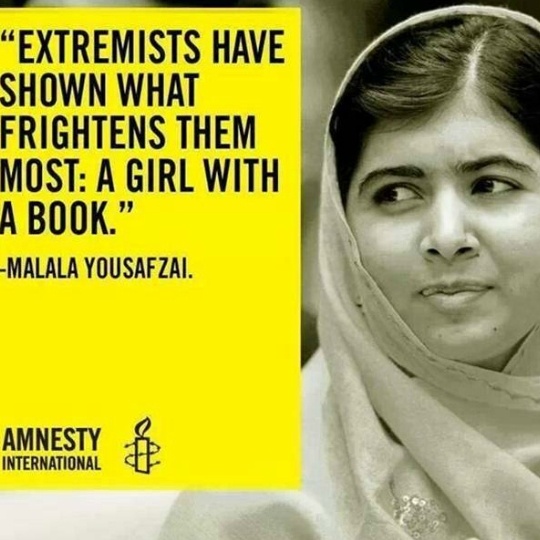
Wouldn't it be awesome if 'sounding like a girl' was a thing to be celebrated?  I celebrate, rejoice, and give thanks for, voices of girls - young women - like Nobel Peace Prize winner Malala Yousafzai.  May she be an inspiration for other girls and women to find and use their own voices without fear...and as they do so, make outdated analogies obsolete and more than a  little ridiculous.

Friday, 19 September 2014

'x' marks the spot: Scottish Referendum thoughts

Today I made my mark.
'x'
No signature.
Just my mark.
The historian has not yet left the building of my soul: fleetingly, I thought of manuscripts poured over in the course of my research.  
Of other marks made, instead of signatures, by folk without the benefit of an education basic enough to write their own name.
'x'...
And, today, people who love and live in Scotland were marking 'x's and making a wee mark in the fabric of history on this referendum day.  
Such a little thing, yet such an enormous thing, 
this freedom to exercise the democratic right to voice your opinion.

Just over two hours ago, ballot boxes were sealed and sent off to be counted.
'yes'
or
'no'
to the simple, unadorned question on the paper:  
"Should Scotland be an independent country?"

After 307 years of Union, should we stay or should we go?

At the beginning of the campaign, 'no' were well ahead by 22 points.
In the dying days of the campaign, pollsters were saying 'too close to call'.
And in between?
Somehow people who perhaps had long ceased to believe that their voice mattered,
that their vote could make a difference, began to register themselves to vote.
Began an ongoing national conversation...
'What's best for our country?'
'What vision do we have for our future?'
In the corridors of power, in supermarkets, the hairdresser's, in the pub, 
and on the high street, people got interested in matters political.
An astonishing 97% of the electorate registered to vote.
Even as the sealed ballot boxes are being opened and counted, 
it's predicted over 90% of the electorate might actually have turned out.
We may yet make history for sheet numbers of turnout in a 
modern electoral campaign in the West.
Democracy is suddenly cool in Scotland.

There's been a gathering momentum, an energy, an engagement.
There's been a feeling in the air that has given me hope.
This has been a process unlike anything I've ever seen before.
On both sides of the debate, there have been some minority extremists who've
let their own side down by unacceptable behaviour in isolated incidents.
In general, however, while it's been robust at times, 
there's also been humour and wit; 
people have been mostly good-natured,
law-abiding, and peaceful.

Should the vote be 'no', I don't believe we'll slide back into a status quo:
the tectonic plates of this wonderful, wee country have changed in some indefinable way.
And I think the shock-waves may yet shake Westminster out of complacency. 
I hope, I so hope so.
I'm praying that the energy, the engagement continues.
When I wake up in about 7 hours time, I suspect we'll know the result.
My own prediction: a very close 'no'.
I'd be delighted to be wrong, but however it pans out, 
the next step is to crack on, work together, harness the energy for
change that's come out of this process, and build the best Scotland we can.
There have been no barricades, no barbed wire, bombs or bullets.
Just an 'x' on a card in a ballot box.
I'm so proud of our wee country, whatever we decide.

Tuesday, 11 February 2014

lectionary leanings: 'well, that's awkward' - Matthew 5:21-37

Although I'm not preaching this coming Sunday - as I shall be in Israel [she said, casually!] - a conversation in a facebook group prompted some thoughts on the upcoming gospel text for the day: Matt. 5: 21-37. I love being a part of a group who are happy to engage in conversation both casually and deeply about the texts for preaching. I value the variety of approaches and insights - they both feed my soul and stimulate my own thinking. The verses concerned are:
21“You have heard that it was said to those of ancient times, ‘You shall not murder’; and ‘whoever murders shall be liable to judgment.’ 22But I say to you that if you are angry with a brother or sister, you will be liable to judgment; and if you insult a brother or sister, you will be liable to the council; and if you say, ‘You fool,’ you will be liable to the hell of fire. 23So when you are offering your gift at the altar, if you remember that your brother or sister has something against you,24leave your gift there before the altar and go; first be reconciled to your brother or sister, and then come and offer your gift. 25Come to terms quickly with your accuser while you are on the way to court with him, or your accuser may hand you over to the judge, and the judge to the guard, and you will be thrown into prison. 26Truly I tell you, you will never get out until you have paid the last penny.27“You have heard that it was said, ‘You shall not commit adultery.’28But I say to you that everyone who looks at a woman with lust has already committed adultery with her in his heart. 29If your right eye causes you to sin, tear it out and throw it away; it is better for you to lose one of your members than for your whole body to be thrown into hell. 30And if your right hand causes you to sin, cut it off and throw it away; it is better for you to lose one of your members than for your whole body to go into hell. 31“It was also said, ‘Whoever divorces his wife, let him give her a certificate of divorce.’ 32But I say to you that anyone who divorces his wife, except on the ground of unchastity, causes her to commit adultery; and whoever marries a divorced woman commits adultery.33“Again, you have heard that it was said to those of ancient times, ‘You shall not swear falsely, but carry out the vows you have made to the Lord.’ 34But I say to you, Do not swear at all, either by heaven, for it is the throne of God, 35or by the earth, for it is his footstool, or by Jerusalem, for it is the city of the great King. 36And do not swear by your head, for you cannot make one hair white or black. 37Let your word be ‘Yes, Yes’ or ‘No, No’; anything more than this comes from the evil one
One of the group had posted a comment observing that she really did not like the text - which, given some of the content, is understandable. In response, another noted that, in sensitivity to some folk who'd be visiting the church that Sunday, the reading would be stripped a little - especially the 'divorce' stuff. Some said 'find another text to preach on, then', while others encouraged a 'don't shy away from the hard texts' approach. A couple noted that by omitting the text, the original poster could be storing up a homiletical problem a little ways down the track when the gospel unpacked some other matters that were based on this chapter. So, a nice diversity of opinion already, with regard to whether to preach on it or not. 

I think that I'm inclined to the view that when these so called 'hard' texts turn up, we should face them square in the eye.  And that it's completely okay to say to a congregation 'you know what, I struggle with this reading.'  Chances are, they do too - it may even come as a relief to know that the minister is also sweating somewhat with regard to the passage.  Given that, if I were preaching this coming Sunday, I'd still go for the gospel text - warts 'n all - and think my sermon title would be 'Well, that's awkward...!', thus acknowledging the difficult sounding stuff in the reading, and also the possible difficulty regarding what on earth to do with it.  However, having taken that communal deep breath with the congregation, I'd also acknowledge that the passage is a massively rich text and there are many ways in which to approach it.
Looking at the passage, my own tendency would be to try and stand back a little to try to see a broader theme and try to avoid the potential of becoming bogged down in the individual offences.  As I read it, this passage is part of a much wider discourse on how to love one's neighbour - the offences mentioned are all potential causes for dispute and disharmony undermining personal / familial/ community/ divine relationships:
murder, anger management, insults, adultery, divorce, false witness.
Thinking of John Calvin [as I often do] and his understanding of the godly community being an harmonious community - ordered and peaceable, and thus potentially at least, demonstrating a foretaste of the kindom of heaven - perhaps I'd invite folk to think about how to live in love/ harmony with one another?
For me, then, the key verses would be:

'23 So when you are offering your gift at the altar, if you remember that your brother or sister has something against you, 24 leave your gift there before the altar and go; first be reconciled to your brother or sister, and then come and offer your gift.'
We are called to be a community of reconciliation - as God has reconciled us in Christ, so we are to be reconciled one to another and as we do so, live into our calling as Christ's body in the world to bring the message of the gospel of peace to the world.  The challenge of preaching upon a 'hard' text is paralleled by the challenge it is to live as reconciled people...


And I am now filing that thought away for the next time the text comes around!! 

Friday, 30 August 2013

Watch, O Lord...

and with a majority of just 13, the UK will not take part in what would have been an illegal military intervention.  And yet some intervention needs to be made in Syria - but what, how, when, and by whom?  I feel so helpless in the face of institutions such as the UN seemingly unable to act, I despair at the hawks circling round - more like vultures - in various Western governments, who seem itching for a fight.  Regardless of whether and what kind of intervention occurs. or does not, in Syria the overall scenario is a grim lose-lose situation.  The use of chemical weapons on one's own people to retain power - represhensible.
In the face of unspeakable acts and appalling suffering, feeling numb, and having no earthly idea of what the best way forward would be, I turn to my old friend Augustine, and offer up the words of his prayer this evening:
Watch, O Lord, with those who wake, or watch, or weep tonight,
and give Your Angels and Saints charge over those who sleep.
Tend Your sick ones, O Lord Christ.
Rest Your weary ones.
Bless Your dying ones.
Soothe Your suffering ones.
Pity Your afflicted ones.
Shield Your joyous ones.
And all for Your love's sake.
Amen

Saturday, 11 May 2013

careless talk does cost lives: musing on *that* General Assembly report, May 2013

Having posted the following in a closed space amongst friends, I have decided to open it out a little for some possible discussion.  It concerns my horror, yes, I will use that word, at some of the comments made in the Church of Scotland report coming to the General Assembly this year re. LGBT people who are in relationships, and whether they should be allowed ordination/ ministry roles.  Amongst some of the very badly worded parts of the report, were comments on the death penalty....
 
Dear wonderful ones
Maybe I'm off-beam on this, but crumbs, regardless of what side of the theological fence, there are comments that are just ...
well... words fail me... :(

The Church of Scotland has been undergoing, for what now seems a millennia, conversations upon LGBT folk and the Kirk. This latterly with particular reference to the ordination of LGBT people who are in a relationship.
In 2011 our General Assembly voted, unexpectedly, to set up a Commission tasked with exploring theologically what was termed the 'revisionist' [or moderate to liberal] trajectory and report back in 2013.
The report has now been out for a week. [link below].

The Commission has neither explored the 'revisionist' trajectory, nor has it done any basic theology -
e.g.
how do we explain the existence of 'gayness';
questions concerning the image of God/ and being created in God's image;
practical/ pastoral theology - if we insist upon imposing celibacy/ imposing a higher standard of morality on LGBT people what implications does this have on the way we minister to LGBT folk? etc. etc. etc.

What has been presented is a rehashing of the same old hermeneutical set-pieces...including those 'joyful friends' - bestiality, paedophilia, incest, and some glorious unthinking misogyny as well.
These I am used to, even as I shake my head wondering how they are even deemed to be valid arguments any more.
My problem is with one word: 'however'...
I have been disquieted ever since I read it, and a subsequent comment; both reference the death penalty.

I woke up this morning and 'that' report was on my mind and in my heart;
I realised that there has been a slowly building, cold, clear anger emerging, particularly re pages 79 and 84 of the report and these two comments concerning the death penalty.

Let me highlight these:
note the unstated, yet implied sense of regret that comes across with the very careless use of the word 'however' [my caps], and perhaps also a sense that LGBT folk should think themselves lucky not to be executed any more, [well, at least in the UK] and should just... shut... up.
7.6.3.1.9 Leviticus 20 [p79]
‘We do not seek to apply the death penalty today, hoping that an offender may yet come to faith and repentance in the Lord Jesus Christ, acknowledging their sin and receiving forgiveness. HOWEVER, we must recognise that our God considers such sexual sin as an offence against his nature and his holiness and his appointing such punishment for this sin cannot be ignored or treated lightly.’

And surprising, in light of the 'traditionalist' castigation of 'revisionists' doing so [namely: Jesus never says anything about homosexuality - I would actually agree here with the 'trad' criticism; it is not a valid way of making a case], the 'traditionalist' writers arguing from the silence of scripture to imply the tacit approval of Jesus concerning the execution of gays:
7.6.4.1 The Lord Jesus and the Gospels [p84]
The Old Testament law books prescribe the death penalty for homosexuality (Leviticus 0:13), adultery (Leviticus 20:10) and prostitution (Leviticus 21:9). While Jesus condones neither practice, the Gospels record instances where Jesus did not demand the death penalty for people practising adultery or prostitution. There is no recorded instance of him overturning the law’s requirement for homosexual conduct’.

No. No. NO.
Words are important.
Words are powerful.
These words are not merely offensive,
nor are they just irresponsible.
Let us be clear:
these words are dangerous and could cost lives.
These words above send out a message that subtly - or not so subtly - lend some 'authority' to those countries in which the death penalty does still operate in the case of LGBT folk who are found to be in a relationship.
There is an implied approval that this is the right action.

How, in the name of all that is good and holy, can we approve this report?
I am sitting here quite calmly writing this, but filled with quiet horror at the almost inadvertent revelation of a very, very deep-seated prejudice that so values the ideological point, that it dispenses with the value of human life... in a manner that is so casual as to be chilling.

link - http://www.churchofscotland.org.uk/news_and_events/news/articles/church_theological_report_published_today

Saturday, 24 November 2012

we ordain women because we baptise girls...

The thesis is, rightly, giving me little time to do anything else at the moment; I am immersed in the performances of penitential Protestants and desperately trying to write up.  I did pause, however, the other day to follow the live feed on the discussion and vote for/ against women being ordained as bishops in the CofE.

While I am not Anglican, I am grieving for friends who are - and for those in particular who are training for, or have been ordained into, the priesthood.  I never did quite understand why this was not sorted out when women were allowed to become priests in the CofE 20-odd years ago - by 2 votes I believe.  Then again, I have never managed to quite get my head around the fact that women being called to ministry is an issue - given 50ish% of humanity are women.   We ordain women because we baptise girls...!

The strange technicalities of voting meant that while an overwhelming majority voted in favour of allowing women to become bishops, the motion fell by just 6 votes; each of the three 'houses' needing to have a two thirds majority, which was not what happened in the house of laity.  I was reminded of our own arcane ways and processes: of motions proposed at General Assembly and sent down under the Barrier Act, that come back with a resounding 'no' a year later, this often based on the will of tiny presbyteries of 6 or 10 or 12 parishes who have the same power as larger presbyteries of 50, 80, or over 100 parishes within them. 

While I am not always convinced that the church should bring things in on a majority vote, neither am I convinced by the checks and balances that have been put in place with the (rightly so) intent to safeguard against whim, to ensure folk with different views don't get trodden on, etc.  What I am more convinced about, however, is that the systems in place within our institutions are set up in a default position that mitigates against bringing any kind of change.
No system put in place will please everyone; no system is perfect.
And yet, despite our flawed systems and institutions which seem to be built as monuments to fear, God still manages to manoeuvre between the cracks despite our 'best' intentions to stymie things.
I wonder what building systems based on trust would look like, and how they might work? 
Systems designed to work with God and each other in generous grace and mutuality and without the fear that needs to control who is in, who is out, and who gets to make the rules?

In the meantime, came across this courtesy of a friend, which is as fitting a response to what occurred within the CofE this week as I have seen:
When I am ordained, I shall wear purple
with killer heels and bright red lipstick
And I shall go round preaching from the Bible
...The liberating truth that Jesus calls women
and tell those who say otherwise that it is they,
not I, who are bad theologians.

I shall sit down with fellow clergy
when we are tired of fighting for equality
and going the extra mile with grace when we are put down,
And we will make up for it:
by encouraging one another as Scripture says,
and praying for those who abuse us,
and rejoicing that we are suffering
(but just a little bit) for Jesus,
And we might even eat some chocolate.

I will adopt the ordination name “Junia”,
and remind those who object,
that there may be a boy named Sue somewhere in the world,
but there probably isn’t.

But now we must face the world,
Who think we are traitors to our sex
For working for the Church
And face our brothers and sisters who think
We are being unbiblical
And face those in our Churches
who have failed to notice the pain this week has brought.
And we will go in the strength of Christ.
We will not turn our backs on our calling
Because God is not finished with the Church,
And He is faithful.

But maybe I ought to practice a little now?
So people who know me are not too shocked and surprised
When suddenly I am ordained, and start to wear purple.

by Rev Mia Smith