pages

Monday, 1 December 2014

'O that you would tear down the heavens!' A sermon for Advent 1B

High time I got to blogging again!  Slightly distracted over the last several weeks, having moved and been inducted into new charge... *big grin*
This morning's sermon to kick off Advent - and possibly my favourite Advent reading.

SERMON ‘O, that you would tear down the heavens’ 
Isaiah 64: 1-9

let us pray:
May the words of my mouth and the meditations of all our hearts be acceptable in your sight, O Lord, our strength and our redeemer.  Amen.

O come, O come, Emmanuel,
and ransom captive Israel,
that mourns in lonely exile here
until the Son of God appear...

It’s the first Sunday of Advent:
the beginning of a new church year.
New life
Hope renewed.
From Advent last year,
through to Christ the King Sunday last week,
we’ve moved through the various church seasons - the liturgical calendar -
and, as we’ve done so, as a community,
age-old, familiar stories from the bible have been heard.
Our Gospel readings will have covered the birth, life, ministry,
death and resurrection of Jesus
Other readings from the New Testament will have focused upon the community of followers,
and of making sense of what it is to follow Jesus.

Over the course of Old Testament readings through the year,
we’ll have been reminded
of the journey of the people of Israel:
from wandering in the wilderness,
to the establishment of a nation,
to the overthrow of that nation
and of exile and return.
There have been stories of great leaders chosen by God;
and stories of God’s prophets -
calling some of these same leaders
to follow and trust God more closely...
to lead the people wisely and well.

Overall, in both Old and New Testaments,
we, as God’s people have journeyed with God’s people - through the ages,
journeying together as we try to understand who this God is that we follow,
and how to live - how to be - his people.

Our Old Testament reading this morning is set in a time
when God’s people find themselves in dire circumstances: 
when all around them feels dark;
where the flicker of hope is all but extinguished.
The nation of Israel has been comprehensively defeated
by the new superpower in the neighbourhood, the Babylonians. 
Those who are deemed valuable:
the elite of the nation,
the best and the brightest,
have been summarily marched off to the great city of Babylon to live out their years in exile.
Throughout this approximately 70 year period, the prophet Isaiah, and his followers, act as God’s messengers to the defeated, despairing people of God -
as voices of hope when all seems hopeless.
Voices holding the people of God.
and God
to account.

This particular passage is a cry of rage and lament;
the prophet’s plaintive call to God to act -
‘O that you would tear open the heavens and come down’
It’s a cry calling upon God to make himself known
to his people
and their captors.
The prophet asserts that
by redeeming - rescuing Israel -
God’s name,
God’s power
will be made known.

In the midst of lonely exile in Babylon
feeling abandoned by God
God’s people wait,
wait for him to appear.
But why, even when feeling abandoned,
is there a hope
an expectation
that God might appear to them?
That God might just rescue them?

O come, O come thou Lord of might,
who to thy tribes on Sinai’s height,
in ancient times didst give the law
in cloud and majesty and awe...

As Isaiah calls upon God
to tear open the heavens and come down,
he reminds the exiles of their past -
And, it would appear, he also reminds God.
There’s some history here.
There’s a relationship that needs to be looked at:
there’s a covenant - an agreement -
binding God and his people together.
While God’s people are to honour, serve, worship, love, and be faithful to God...
The Lord of might - mysterious, majestic, and awesome,
is bound:
bound to protect and to lead his people.

Isaiah reminds God:
‘you did awesome things’
One such awesome thing is found in the
giving of the law on Mount Sinai -
the law showing how to love God
and to love neighbour -
and through doing so,
to create an ordered, harmonious community:
the peaceable kingdom...
a foretaste of the kingdom of heaven.

Isaiah recalls the unexpectedness of God -
the awesome God who,
when giving the Law
does indeed come down from the heavens
breaks through into finite time and space
and makes himself more fully known
on the mountain...
and, as he does,
causes the mountains to quake
and to tremble...

Isaiah says to God:
 ‘You’ve done this before..
come and do it again...
act on behalf of those who wait for you’
To the people waiting in near-darkness
a spark of hope is being kindled.

O come, thou Rod of Jesse,
free thine own from Satan’s tyranny;
from depths of hell thy people save,
and give them victory o’er the grave...

Will God free them? 
He has done so in the past -
he can do so now
and in the future.
From the depths of hell that is exile in Babylon
there will be a return to the Promised Land...
But there will also be more waiting -
the people of God will continue to await the promise of a coming Messiah
and the fulfilment of all things once they arrive back to Palestine...

Several hundreds of years later,
far away from Babylon,
and in a backwater of the Holy Land itself - Bethlehem -
the cry of Isaiah echoes through the land -
God tears down the heavens and comes down:
the promised Rod of Jesse.
A mighty deliverer -
gurgling in a manger.
The expected appearance:
so thoroughly unexpected.
The promise of hope
made flesh and bone...
to rescue God’s people from the tyranny and fear of death,
as he overcomes it
by his own death, and resurrection:
the resurrection life that kindles hope
of a new life for all humanity.

O come, thou Key of David, come,
and open wide our heavenly home;
make safe the way that leads on high,
and close the path to misery...

What are we waiting for?
We wait for Jesus, the Key of David...
who will come again
and fling open the gates to our heart’s home;
for Jesus, who leads us safely to a place of rejoicing,
a place of hope.

We need not fear
for we are not doomed to destruction and loss:
God loved the world in this way -
that hope was born among us -
divine and yet human -
that whoever believes in the Son will not perish,
but have life everlasting.

We need not fear
for we don’t have to accept that hunger and poverty and injustice will always win...
We have hope -
for the one in whom we trust
and for who we wait
has come to give life, life abundantly, justly.
We need not fear
for violence and hatred will not prevail -
for unto us, a child is born,
unto us, a Son is given
and the government shall be upon his shoulder,
his name shall be called wonderful councillor, mighty God, the Everlasting, the Prince of peace.[1]

We need not fear,
for there is hope and light and life:
the day, the hour is coming...
Soon and very soon
we are going to see our king -
tearing open the heavens,
breaking into human history,
walking among us
with us:
God, in Jesus;
God who is for us.
This is our hope,
this is what we watch and wait for over Advent -
we await the one who is the ground of our being
the one closer to us than breathing.

As we wait to remember,
and celebrate anew the coming of the Christ child,
have courage
be not afraid,
the light of hope will never be put out...

O come, thou Dayspring, come and cheer
our spirits by thine Advent here;
disperse the gloomy clouds of night,
and death’s dark shadows put to flight...

Rejoice!  Rejoice!  Emmanuel
shall come to thee, O Israel.
Amen.

 [1] riffing on a theme from Daniel Berrigan’s ‘Advent Credo’

Friday, 17 October 2014

'sounding like a girl'

It was a great blog post.
Beautifully written, filled with wise words on boundaries and work-life balance,
and the need to step back and say 'no' at times.
Know yourself.
Know your limits.
Out of courtesy to the blogger, who I respect hugely, and who is a well-known speaker and writer, I'm not going to name them, nor post a link.
Not that they need 'protected', but rather, this is not a post about calling them out: it's about calling out systems and structures that perpetuate misogyny in such a way that it is normalised to the point of subversive, unhelpful near-invisibility.

But back to the post...
In the midst of wise words, a phrase caught my eye,
took me out of the writer's intended train of thought and moved me along another parallel track.
The premise was the difficulty of saying no, and the added difficulty of doing such without a profusion of apologies,
of 'sounding like a girl.'
'Sounding like a girl'...
We've all heard variations of the '...like a girl' phrase:
cry
walk
run...like a girl.

As if there's something inherently wrong, bad, about the way girls - or women - do things.
And it's a phrase that's used at such a subconscious level that the inherent sexism and diminishing of women can be missed utterly.  One day I hope we can all find a more helpful analogy than the 'like a girl' trope which comes with such an implicit negativity regarding the voices of girls/ women.  Centuries upon centuries of thinking/ living/ working within the default framework of male hegemony have had some impact upon a possible female default response: to please, to be nice, to defer, not to make waves (and, should waves be created or anticipated, to apologise and apologise again).  Apologise for what, however?  For our right to exist, for self-determination, our right to express an opinion?
Is 'sounding like a girl' so dreadful?
And if not, what then, is it to 'sound like a girl?'

This:

or perhaps this:

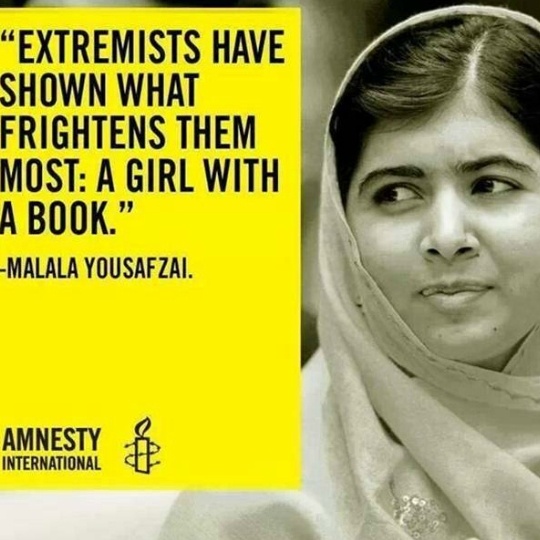
Wouldn't it be awesome if 'sounding like a girl' was a thing to be celebrated?  I celebrate, rejoice, and give thanks for, voices of girls - young women - like Nobel Peace Prize winner Malala Yousafzai.  May she be an inspiration for other girls and women to find and use their own voices without fear...and as they do so, make outdated analogies obsolete and more than a  little ridiculous.

Friday, 10 October 2014

RevGals: random Friday Five

After a long time not playing... here's my RevGals Friday Five.
Karla asks:

1. How do you sign off in your emails, professional and personally? For example, you say “Blessings”, “Take Care”, “Remember, the Devil is watching you” (o.k. just kidding on that one.) Let us know and why… 

Most often it's 'Warm greetings', followed by my name, and then a tag signature quote by Cecil Beaton:
'Be daring, be different, be impractical, be anything that will assert
integrity of purpose and imaginative vision against the play-it-safers, the creatures of the commonplace, the slaves of the ordinary.'

Why?  'Warm greetings' was a way of not writing 'yours faithfully/ sincerely', was friendly but could be taken as formal/ informal.  
The Beaton quote - echoes for me of Rom. 12:2 'do not be conformed to the world, be transformed' - idealist, even at this age, who doesn't just want to wish for change, but to be part of the change I wish to see?

 2. If you were an animal TODAY, what is it and why? 
My day: a case of...'is it hot in here, or is it just me?'

 3. If you get snarky, what triggers it? If you don’t get snarky, please, what is the secret? I am a ray of sunshine in God's glorious firmament ... okay... bad manners and lack of integrity.

4. Look up from your computer/tablet/phone screen. What is the first favorite thing your eyes land on. Describe it. (For example, I just did this, and my eyes landed on a little angel made out of multicolored wires whose head and wings are quite askew because of being chewed upon by my puppy. That aside, I love it because it was a gift from two little girls who came often to my office in my last call to play with all the tshotke on my table. They wanted to add to it.) 
Ah, looking up, my eyes were drawn to my mock Rennie Mackintosh fireplace - perhaps it is getting to the time of year to indulge my inner pyromani...er, light the fire. 

5. Do you have a favorite pair of socks? Tell us about them!
They are beginning to fall apart, but yes: my Jonah in the whale socks :)

Wednesday, 8 October 2014

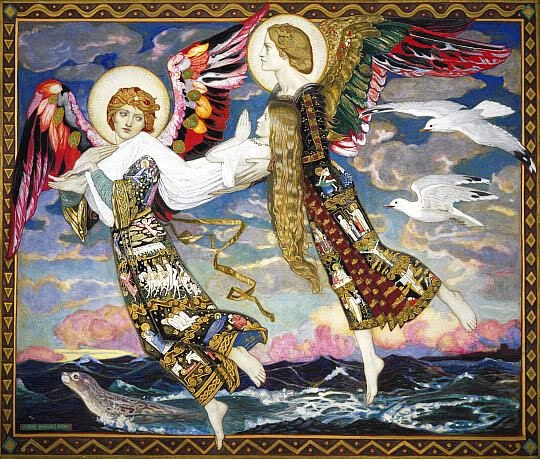
beyond words: St Bride by John Duncan

St Bride, John Duncan c.1913
Ever since I was introduced to this painting back in 1997, by the wonderful Mary Low, I have loved it.  Every time I visit the painting another detail catches my eye and makes me pause.  There's a richness of colour and movement that conveys so much without needing to resort to words, and which leaves me silent in its wake.
   
The subject matter is very much informed by the Celtic Revival/ Twilight movement, and my inner pedant wrestles slightly with my more romantic side because of the anachronism: St Bride being transported across the water - and through time - to Bethlehem at the birth of Christ, to act as midwife for Mary.  My mind flashes to Dr Who very briefly but, almost immediately, the beauty of the painting grabs me, and, like Bride, I too, am transported.  

At the centre, the stern face of the angel whose eyes, and indeed, whole body are focused forward upon the task and destination.  There's an immense dignity and strength, a strength seen in the angel's hands as it carries the precious cargo onward.  A suggestion of a cross with the angle of Bride's body echoing the angel's wing...Bride, the pious, who even in her sleep is seen in an attitude of prayer, and wearing white for purity.  

In contrast to the near-severity of the central angel, there's a tenderness in the leading angel's face, which turns back and looks upon Bride with care and compassion.  The richly detailed robes worn by the angels tell stories from the life of Christ.  Perhaps they also tell a story in miniature of the artist, John Duncan; on the leading angel, is the clown/ holy fool leading the procession a self-portrait of one who may have been a little mad?  Earthly creatures meet this heavenly procession.  Bobbing amidst the sea-foam, a seal crests the waves while two rather cheerful seagulls follow.  

I love how the subjects in the painting are not contained by the border: a halo, wings of angel and bird, and feet break free from the constraints that seek to impose order.  The artist perhaps thinking 'outside of the box' way before the term was coined.  

It is an odd thing, this.  Although I can describe various aspects of this painting, what I can't at all describe is how - or why - this painting moves me so, or why it is one of my favourites.  All I know is that, somewhere in the deep core of my being, the painting just strikes a chord in some way.  I could use the words 'transcendent', or 'beauty', but perhaps it's okay to accept that some things go beyond words.  

Friday, 19 September 2014

'x' marks the spot: Scottish Referendum thoughts

Today I made my mark.
'x'
No signature.
Just my mark.
The historian has not yet left the building of my soul: fleetingly, I thought of manuscripts poured over in the course of my research.  
Of other marks made, instead of signatures, by folk without the benefit of an education basic enough to write their own name.
'x'...
And, today, people who love and live in Scotland were marking 'x's and making a wee mark in the fabric of history on this referendum day.  
Such a little thing, yet such an enormous thing, 
this freedom to exercise the democratic right to voice your opinion.

Just over two hours ago, ballot boxes were sealed and sent off to be counted.
'yes'
or
'no'
to the simple, unadorned question on the paper:  
"Should Scotland be an independent country?"

After 307 years of Union, should we stay or should we go?

At the beginning of the campaign, 'no' were well ahead by 22 points.
In the dying days of the campaign, pollsters were saying 'too close to call'.
And in between?
Somehow people who perhaps had long ceased to believe that their voice mattered,
that their vote could make a difference, began to register themselves to vote.
Began an ongoing national conversation...
'What's best for our country?'
'What vision do we have for our future?'
In the corridors of power, in supermarkets, the hairdresser's, in the pub, 
and on the high street, people got interested in matters political.
An astonishing 97% of the electorate registered to vote.
Even as the sealed ballot boxes are being opened and counted, 
it's predicted over 90% of the electorate might actually have turned out.
We may yet make history for sheet numbers of turnout in a 
modern electoral campaign in the West.
Democracy is suddenly cool in Scotland.

There's been a gathering momentum, an energy, an engagement.
There's been a feeling in the air that has given me hope.
This has been a process unlike anything I've ever seen before.
On both sides of the debate, there have been some minority extremists who've
let their own side down by unacceptable behaviour in isolated incidents.
In general, however, while it's been robust at times, 
there's also been humour and wit; 
people have been mostly good-natured,
law-abiding, and peaceful.

Should the vote be 'no', I don't believe we'll slide back into a status quo:
the tectonic plates of this wonderful, wee country have changed in some indefinable way.
And I think the shock-waves may yet shake Westminster out of complacency. 
I hope, I so hope so.
I'm praying that the energy, the engagement continues.
When I wake up in about 7 hours time, I suspect we'll know the result.
My own prediction: a very close 'no'.
I'd be delighted to be wrong, but however it pans out, 
the next step is to crack on, work together, harness the energy for
change that's come out of this process, and build the best Scotland we can.
There have been no barricades, no barbed wire, bombs or bullets.
Just an 'x' on a card in a ballot box.
I'm so proud of our wee country, whatever we decide.

Sunday, 31 August 2014

'In the name of love': sermon for Ordinary 22A

Texts:
Exodus 3:1-15
Matthew 16:21-28
Romans 12:9-21

In our service last week, 
we were thinking about names 
and I want to continue along that theme a little this morning. 
At the beginning of her sermon last week,
[minister] asked us all if we’d ever wanted to be called something else,
and for me, it triggered off two wee lines of thought.
The first?
I remembered waaaaaaay waaaaay back to the first year 
- actually, the first weeks -
of high school. 
Our school headmistress, Mrs Goninon, stood in front of our year group, 
and asked us exactly the same question:
if we had the opportunity to name ourselves, what name would we choose?
And then, without skipping a beat, she looked into mid-distance, 
her eyes misting over as she set the scene in her head, and said with a dramatic sigh...
‘For me...     it would be...
Esmeralda...’
There was a very long pause.
One hundred 12 year olds looked at her,
then at each other,
wondering what on earth she was on about.

She continued, with another sigh....
‘when I think of the name, Esmeralda, I see a vast ocean, 
and in the middle of that ocean, a beautiful yacht 
- with such clean lines...the sails are up, 
and she dances upon the sun-kissed waves...’
Apart from thinking that she’d...well... lost the plot,
I remember thinking: ‘but, I quite like my name.’
... this triggered off the second line of thought:
that actually, maybe I don’t really like my name at all...
because ‘Nikki’ is not the name
that’s on my birth certificate, or my passport...
My birth name is actually...
...no, not Esmeralda
it’s ‘Nicole’.
Now, I have no idea who this ‘Nicole’ person is, 
because even if someone calls me that, I don’t actually realise 
it’s me who's being addressed.

Names are funny things...
they serve a very important basic function:
it’s the first thing you tend to do when meeting someone 
- you introduce yourself...
you give your name.                                               
And for the peoples living in the lands of the Ancient Near East -
the lands that form the geographical background to our bible...
the lands of Moses, of Jesus, of Paul...
names were powerful things -
and the giving of your name to someone else was seen 
as giving away some of your power... 
a part of who you were.

And so, in our Exodus reading, we find something quite extraordinary 
happening in the desert, by Mount Sinai...
it’s not so much the burning bush that’s extraordinary, 
- although, that’s quite something -
it’s the conversation between God and Moses.
Moses has long left Egypt behind. 
He’s married, and helps his father in law by tending the family herd of sheep and goats.
And one day, as he’s doing this, he stumbles upon a strange scene...
and finds himself in a completely unexpected conversation
with someone who knows,
and calls     out     his    name.

Moses, having first been told to take off his shoes, 
is instructed to head back to Egypt
and lead the Israelites to freedom and the Promised Land.
It’s probably not quite the day he’d planned on,
when he’d been having his toast and cuppa at breakfast.

Moses points out to God that
while it’s all very well to march into Egypt
and say to the Israelites
‘the God of your ancestors sent me,’
they might well want a little more information...
And then, Moses does an incredible thing:
he asks for God’s name -
basically, for God to give away a little of who he is, 
in a sense, to give away an aspect of his power.
And in the giving of his name to Moses,
God reveals just how powerful he is:
I AM ...

Okay, that seems a bit ambiguous,
a bit enigmatic...
But what God’s saying, in the giving of his name here is this:
I Am ...  completely me -
here is a sense of the utter integrity of God...
I will be who I will be -
He’s saying: I never change...
this God is ...reliable, faithful
but also,
this God,
this name-giving God is saying:
I Am... sufficient,
enough,
able to supply all    your    needs...
not wants - needs...
needs spoken and unspoken,
needs known and unknown.

The name given, demonstrates that this God -
this passionate God 
who wants to liberate his people - is  enough -
more than enough,
more than a match for Pharaoh,
more than a match for all the gods of Egypt combined.
What a name.
and what a conversation.

Thousands of years later,
we’re privy to another conversation
where names feature:
this time between Jesus and his disciples
- and in particular, Peter -
who is actually called ‘Simon’.
We know the story from last week -
Jesus, the Son of God, asks:
‘who do people say I am’
and Peter’s response - 
'you’re the messiah...'
And then, Jesus does something extraordinary -
Jesus gives him a new name 
- from Simon, which means ‘pebble’,                                                              
to ‘Peter’ the ‘Rock’...steadfast, firm. 
The giving of a new name,
is also the implied giving of new qualities, 
new characteristics, to Peter.
...But how quickly things change.

In our gospel reading today, Jesus begins to talk of his mission and ministry,
and of what that will cost...
suffering and death...
and resurrection.
And suddenly, Peter’s given another name,
when he recoils in shock to what Jesus is saying:
when he rejects the message
being spoken, about the cost of following,
when he shows that he’s not yet understood
the full implications of being a disciple.

In response to Peter’s horrified protests,
Jesus calls him ‘Satan’...
 ‘get behind me, Satan’...
Peter the rock, has reverted to Simon, a pebble...
a stumbling stone...
a possible impediment to the work that Jesus must do.
Powerful, powerful stuff.
And then Jesus spells out in detail
just how costly it is to follow him.

To wear the name ‘Christian’,
is to pick up a cross...
lay aside one way of living,
discover a new way to live...
the way of love
Peter will continue to learn and to follow,
to know, and to grow, into that way of love.

And how might we do this...
live the way of love?
Helpfully, Paul, in his letter to Romans,
gives us some practical pointers...
And begins with the nature of love itself:
‘love must be completely sincere’ -
mirroring the love and integrity of God...
We follow,
we pick up the cross,
out of love -
we try to model God’s love in our homes,
in our communities...
showing respect for one another;
honouring each person as someone
who’s been created in the image of God.

From love, comes hope...
and it’s hope that inspires joy...
that helps us be patient with one another
as we pray, and offer hospitality and help to others;
as we work for the common good and
live at peace with everybody;
as we reject the way of violence
by refusing to exact revenge on our enemies -
and choose the more subversive way of love:
by blessing them,
praying for them,
feeding them,
providing water when they thirst...
and in the process,
perhaps just perhaps,
breaking the cycle of hurt and anger,
the escalation of hostility, by overcoming evil with good.
...All this, as we wait
for the fulfilment of the kingdom...
and in the process, build communities of love - 
little pieces of the kingdom of heaven, here on earth -
thy kingdom come,
thy will be done, on earth as it is in heaven’

Names       are powerful things...
And at the heart of the name that God reveals to Moses
is love:
a passionate, whole-hearted love, that is completely sincere,
utterly integrous.
It’s this love, that moves God to be sufficient - 
sufficient enough to liberate, to comfort, to provide.
It’s this love that God, in Jesus, models...
a love that refuses to retaliate,
but instead, on the Cross, seeks to redeem ...
This is the love that we, who are named Christians,
are to model to the world,
even when at times, it’s hard, hard going.

But remember, always remember:
what gives us the courage and the strength,
and the joy to keep going is that:
we are called to follow
in the name of love,
the One whose name means love -
who calls us ‘beloved’...
whose love is real, sincere,
whose love is more than enough,
and who, in love,
walks the way of love with us,
beside us...
forever and ever,

Amen.

Wednesday, 27 August 2014

#RallyRevGals - Sheryl

Another #revgalsrally post...

Today, for no particular reason at all, I've been thinking about the Letter to the Hebrews, focusing on chapter 11:1-40,12:2; pondering the nature of faith, wondering about 'heroes' of the faith, and the concept of being surrounded by 'so great a cloud of witnesses'.  In amongst a list of numerous male 'heroes' mentioned in chapter 11, three women are mentioned but only one of these for her faith - Rahab.  The other two, Sarah and the unnamed daughter of  Pharaoh, are merely there because of their part in the faith-stories of Abraham and Moses.  Time for naming, I thought, and flagging up other, more personal, heroes of the faith.
As I've been reflecting about those who have influenced my own faith, I realise that there is quite a cloud of sister-witnesses who have encouraged and inspired, challenged and consoled, laughed and wept and spoken and listened and walked alongside me on this peculiar faith journey.
It is to this great cloud of sisters and witnesses to the faith that I pay tribute, and to whom I'm profoundly grateful... and so today, let me add Sheryl.

Sheryl was the youth pastor of the parish I daundered along to due to Rosemary.
Two women.
Both listening to a searching 18 year old.
Both treating me seriously...as ...an adult.
Both very generous.
And what incredible generosity of spirit Sheryl had: she gave me the gift of her time.
Shared books with me,
walked me through this wild collection of books called the Bible,
taught me that you neither need lose your brains or your sense of humour to be Christian,
gave me opportunities to test myself and develop skills and gifts along the way.
Standing up in church and doing bits and pieces in worship...okay.
Reading, playing music, teaching Sunday School...seriously?
It was odd to be teaching P7's...but, really, they taught me -
'so, this Noah guy...all these animals in a boat? No way?
Well, that's cool.'
They'd nod wisely and continue the lesson.
Sheryl, I suspect, was also nodding wisely as she watched and listened.

At the end of a year of talking, coffee drinking, doing many mad things in the church,
we sat in the park by the beach after the Sunday School picnic.
She offered a challenge:
'Nobody's going to beat you over the head with a bible to make you
become a Christian, you know.  We've talked for over a year, you've read,
you've thought, and in the end, it comes down to one simple thing:
you make a decision.
Either you become a Christian or you don't.
What are you going to do?  Nobody gets argued into the kingdom of heaven...'
It seemed perfectly reasonable.
And slightly insane.
Diary entry ran along these lines:
5 December, 1982:
S and I were talking again.  Told me 'make your mind up one way or the other'.  
So, I did: today I became a Christian - basically told God 
'okay, if you exist, then let's do this thing.'  No angels sang.  But that's okay.

For a couple of years, until she moved on, she, along with Rosemary, was a trusted
mentor and guide.  I have so much gratitude for both of them and both gave me
such excellent grounding in the faith.

Tuesday, 26 August 2014

freezer jolly good fellow: of Scotland and ice buckets

You'll have seen it.
It's everywhere.
Gone viral.
What?
The 'ice bucket challenge' that's been raising awareness of Motor Neurone Disease/ ALS.

Living in Scotland, we don't need to make any special preparations when it comes to getting enough suitably icy water; we just go outside...

Wednesday, 20 August 2014

#RallyRevGals - Rosemary


My blogging has been utterly lacking and I've been slacking...
So glad the RevGals are providing a little incentive to get some of us back to the blog-face once more.
And so, I offer the following reflection on Rosemary - who was there right at the beginning,
and who opened the door that would eventually set the whole ministry thing rolling.

I was, perhaps, 13.
To my surprise, my mother insisted I go to confirmation classes at the local Anglican church.
The surprise being that, as a family, we did not do church.
Nevertheless, for almost a year, I'd turn up to Father Smith's confirmation classes
on a Monday afternoon when school had finished.
As a relatively good child, I did find the lesson on going to confession a most puzzling one:
neither bank robbing or murder had, as yet, been committed;
what was there to confess?
Still, I made the most of these opportunities in class to try to ask the
annoying and difficult questions.
Poor man.  Yes, I was testing him.
I began to read up on the subject to see what googlies* I could throw at him.

On Sunday, I would head out to the 7.30am service with my slightly hung-over mother,
get the required dose of religion,
and then we'd all head to the beach.
[in the process, observing that communion wine + hangover = not very happy mix]
Even at that age, I remember noticing that, in worship, anyone who did anything was *not* a girl....
The spiritual stuff was interesting, but the visual message I picked up on was that I didn't belong.
After the year had come and gone, and with it, the confirmation, that was it:
church was now officially done 'n dusted.
Or so I thought.

Several years passed.
18, and  now done with school, I'd head off on a Wednesday evening
to the local Scottish Country Dancing classes.
It's where I met Rosemary.
Rosemary must have been in her late 50's by then -
which, to my 18 year old self, was akin to being positively ancient beyond words.
Light grey hair.
Curly.
She drank hot water with a teaspoon of vegemite: unusual.
She also went to church.
Not Anglican; Uniting Church in Australia.
Taking pity on a poor teen reliant on public transport,
she kindly offered to pick me up and drop me home from dancing.

In that car, we talked.
A lot.
I asked questions - so many questions.
She patiently fielded them.
Talked about faith.
Community.
Life, death, the universe.
'But aren't you committing intellectual suicide by being a Christian?'
Books in process of being devoured included Marx, and Sartre
The word 'deaconess' came up in conversation one evening.
Wait.
She didn't just *go* to church...she actually did stuff...and was paid?
Huh?
I visualised my year of confirmation...
Only men did stuff that went beyond being in the pews.
Apparently not.
I do remember sputtering and asking her:
'But, how, as a woman, can you collude with the patriarchy?'
Light reading material at this point consisted of de Beauvoir and someone called 'Greer'.
Graciousness and invitation:
'Why not come along and see?'
I was so intrigued, I did...
and watched, and listened, as a woman led worship and preached.
...oh.

I'm not quite sure what happened that day.
But somehow, somewhere, a door unlocked inside.
Permission.
Belonging.
Encouragement.
I went back the following week.
And the next.
And the one after that.
All it took was a patient, kindly, and very gracious woman
to show me that the door was open,
and that I was welcome.

So many years later, I have no idea where Rosemary is, or even
if she is still alive.
But soon, another door is about to open...
I've completed my training for ordination and am now
looking for a charge.  And so we come almost full circle.
Should I encounter some brash, precocious youngster with lots of
attitude and a myriad of questions, I pray for the same graciousness
and patience shown to my younger self.
Blessings on you, Rosemary.
Oh, and for the record, I still have not, as yet, robbed a bank or committed murder.

*googlie - for the non-cricketers... it's a cricketing term: a type of bowling delivery, which can be quite tricky for the batter.

Saturday, 16 August 2014

'Crumbs...': a sermon for ordinary 20A

based on Matt 15:(10-20) 21-28 and Isaiah 56:1, 6-8

Let’s pray:
May the words of my mouth and the meditations of all our hearts be acceptable in your sight, O Lord our strength and our redeemer.  Amen.

It’s not easy, being a disciple.
There you are, having left your nets,
your flourishing tax business,
to follow this rabbi, Jesus.
He has some pretty amazing things to say -        
but not everyone in the wider community is particularly chuffed by what they hear.
He seems to like challenging the religious authorities -
making them uncomfortable...
and sometimes, making you rather uncomfortable in the process.
His cousin John did a similar thing,
and...that didn't exactly turn out well.

He throws some pretty astounding
on-the-job training your way,
like catering for the multitudes
or walking on water.
He does some pretty astonishing things too.
Miracles, sure.
But... he also seems to like spending time with the kind of folk 
your mother always warned you about -
you know,
the edgy ones, the outsiders...
the ones who are definitely
‘not     like     us’...
the ones who don’t belong.

It’s hard, being a disciple,
because you find yourself so conflicted at times:
his words, his deeds, and sometimes the company he finds himself in,
often seem to get attention:
the wrong sort of attention.
Abandon any hope of future career
advancement here...
following the rabbi will not only
not make you rich,
you may also lose your respectability.
And yet,
there’s something about him:
he’s a visionary, a prophet,
and you occasionally wonder:
could he be the Messiah
with all his talk of the kingdom of heaven.

It’s not easy, being a disciple.
Perhaps it never has been.
If you think about the long history
of the children of Israel
it’s been a pretty mixed bag of
blessings and woes:
God’s promise to Abraham - of becoming a great nation...
and yet, becoming a nation of slaves in Egypt.
God’s deliverance under the leadership of Moses
and then... 40 years wandering and wondering in the desert.
Reaching the Promised Land,
and crowning your first king,
only to discover that Saul really isn't going to cut the mustard...
The golden years of God’s beloved king, David...
and Solomon the wise, who ruled in splendour...
but then the nation dividing into two...
weakened by infighting.
The kingdom of Israel eventually becoming a spent force
in the face of the might of other kingdoms...
and eventually conquered.
The temple destroyed
the best and brightest sent into exile...
The homecoming,
the rebuilding,
the hope for the future...
followed by further kingdoms
taking over the land...
until eventually, the Roman occupation.

And then,
...Jesus turns up.
He talks of a kingdom
that doesn't follow the usual format of
‘might equals right’,
a kingdom which doesn't put a lot of store 
in power and prestige at the expense
of the weak and the vulnerable...
A kingdom that is totally upside-down
and unlike any other:
the kingdom of God -
the kingdom of heaven.

It isn't easy, being a disciple,
but talk of this very different kingdom,
this very different way of being,
intrigues you enough to want to know more.
Which is why you find yourself
following the rabbi
as he travels the land,
walking around towns and villages,
and where you often land up
in awkward situations.

He’s just offended the Pharisees again -
this time in a conversation about things clean and unclean.
You think the plan to move on to another area is a good one,
except you find yourself in Gentile territory -
with all their strange ideas and customs -
pfft, dogs, the lot of them.
Not like us.
And now there’s some wifey who’s chasing alongside shouting out,
causing a scene.
It’s embarrassing.
It’s...  awkward.
You keep your head down, and keep walking...
and, to your relief,
so does the rabbi.
He outright ignores her:
actually, it’s about the only socially acceptable thing to do 
in the circumstances.

She keeps following, making a scene.
Perhaps the rabbi's silence isn't actually helping - 
maybe he needs to be more firm,
tell her to shove off.
Tell her ‘sorry, love, but you don’t belong here - you’re not one of us.’

And, it seems like he’s going to do just that.
Do the sensible thing;
the right thing,
tells her that it’s simply not in his job spec to speak to such as her.
But instead of going away,
...she stays,
makes an even bigger spectacle of herself.
She falls on her knees and begs...
‘Lord, help me.’
...Funny, Peter said the same thing the other day,
when his experiment with walking on water went wrong.
Seems she thinks that anyone
who calls on the name of the Lord
will be saved. ...

They get into a conversation.
To share, or not to share?
Is it fair to throw the children’s food to the dogs -
to people like her?
Even with that usual, casual insult,
she persists...
a strange clash of cultures here:
dogs are scavengers, pests...
for her, they’re family pets...
she talks of puppies and crumbs.
Crumbs...
And suddenly you remember:
you see in your mind’s-eye 
12 baskets of left-overs
from an improbable feast of a couple of days ago.
So     many     crumbs...
And you’re shaken out of your thoughts as you hear him
marvel at her faith
hear him agree to heal her daughter.
And you know that even as he’s said the words,
somewhere in a house nearby,
a young girl has been restored.
And somehow,
you can almost hear the crazy upside-down kingdom’s borders
getting bigger...
enlarging
expanding...
where all belong,
where all are God’s children,
not just the children of Israel.

It isn't easy, being a disciple.
Perhaps it’s never been.
Here, in the 21st century, with the benefit of hindsight,
we look back over 2 000 years of church history
and see a mixed bag of blessings and woes,
as disciples through the centuries
have tried to work out what following
Jesus is all about.
Too soon, in the history of the Church,
followers began to buy into the idea of 
building the kingdom of heaven in brick and mortar...
in gold and marble...
caught up in thinking of power based on
earthly models:
of getting caught up in carving out an earthly empire 
where the nations of the earth would 
submit       or   be    crushed.
Where entry was through conversion by the sword 
as the New World was discovered...
where entry was by agreeing to adhere
to long lists of rules and regulations
and if not,
the doors of God’s grace would be slammed firmly shut.
Where the vision of the kingdom of heaven
decreased...
grew smaller and smaller
and only allowed the right sort of people in -
the ones who were just like us.

Somehow, over the centuries,
the children of God appointed themselves 
to the task of being God’s gate-keepers -
holy bouncers -
and in doing so, wholly losing sight
of the vision of the heavenly kingdom
that both the prophet Isaiah and Jesus saw:
a kingdom that was bigger, and broader, than imagined.

It isn't easy, being a disciple
but nothing truly worthwhile is easy.
We’re called to be uncomfortable at times
because as Christ’s body here on earth,
we’re called to share
in the bringing in of the kingdom of heaven -
a kingdom where the powerful are challenged
and where the lowly are raised to places of honour;
a kingdom of peace
a kingdom of rich, and glorious diversity
that breaks down the barriers of discrimination
and includes the kinds of people
that our mothers may just have warned us about.

It’s a kingdom of goodness, justice, and caring for one another:
where the gates are flung wide open
for all to enter in;
a kingdom that is always, always about God’s 
immeasurable generosity and grace:
where all can 'fit under YHWH's umbrella' [FOTW]
where all may come and sit around God’s banqueting table -
not offered crumbs,
but invited to feast,
to celebrate life, in all of its abundance...
...where all it takes is the faith,
the willingness to believe that with God
all things are possible...
The poet, R. S. Thomas described the Kingdom like this:
It's a long oway off but inside it 
There are quite different things going on:
Festivals at which the poor man
Is king and the consumptive is
Healed; mirrors in which the blind look
At themselves and love looks at them
Back; and industry is for mending
The bent bones and the minds fractured
By life.  It’s a long way off, but to get
There takes no time and admission
Is free, if you will purge yourself
Of desire, and present yourself with
Your need only and the simple offering
Of your faith, green as a leaf.
Amen